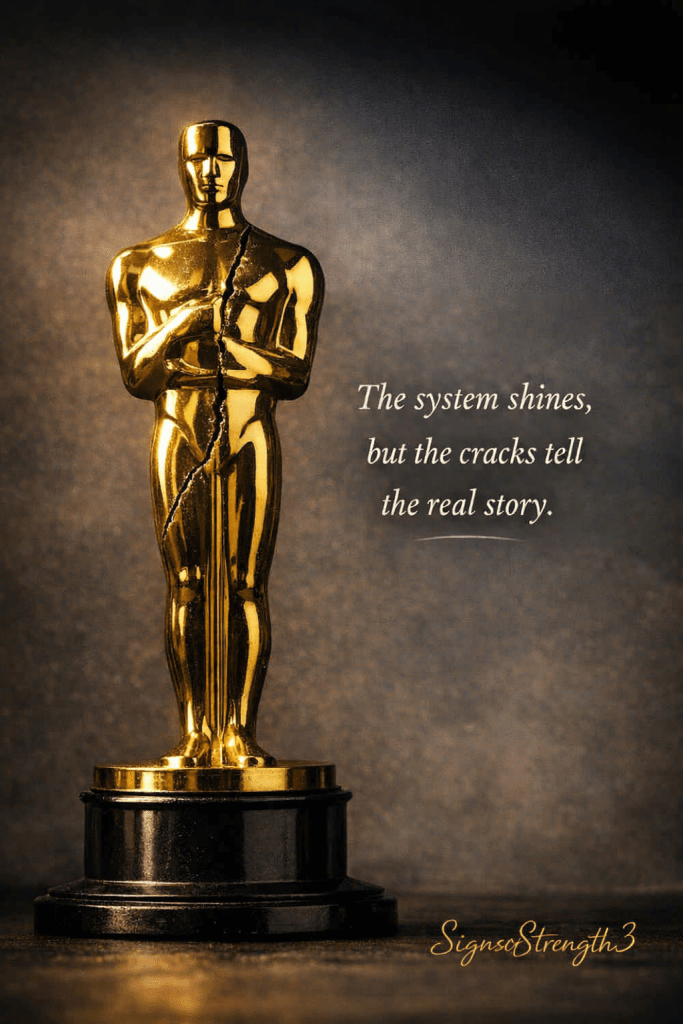
Author: SignsOfStrength

  • When Blame Becomes a Lifestyle

    Let’s talk about it.

    Unmasking the Cycle

    I’m not here to beat up on men or women.
    I’m not here to judge, attack, or tear anyone down.
    I’m a coach — and my assignment is to expose what some people are afraid to see.

    Growth requires honesty.
    Healing requires truth.
    And accountability requires courage.

    Some people live in denial about who they are and how their behavior affects others.
    Some women accept and excuse certain men’s behavior because it feels easier than facing the reality of the pattern.
    But when you step back and look around, you start to see the same cycle repeating in different homes, different relationships, and different lives.

    My goal is not to shame anyone.
    My goal is to shine light on the patterns that keep people stuck, hurting, and repeating the same mistakes.

    Because you cannot change what you refuse to acknowledge.
    You cannot heal what you keep hiding.
    And you cannot grow from what you pretend isn’t happening.

    This blog is not about blame — it’s about awareness.
    It’s about truth.
    It’s about breaking cycles.
    It’s about helping people see themselves clearly so they can finally move forward.


    When the Mask Finally Cracks

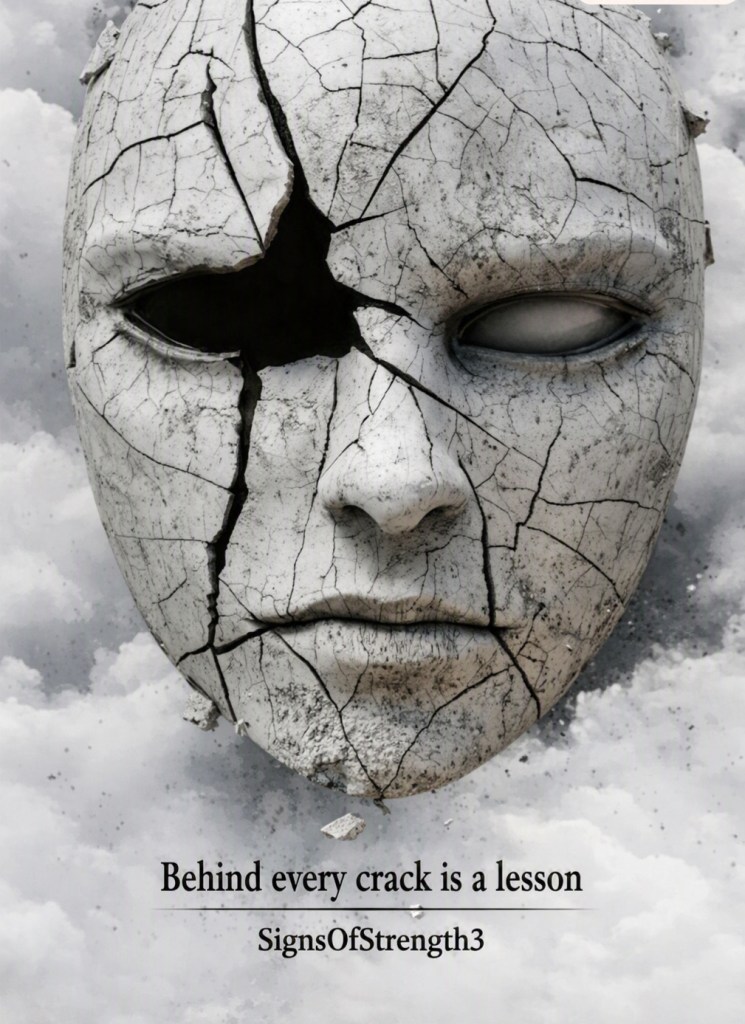
    Some cycles don’t reveal themselves until the mask finally breaks.
    Some truths stay hidden until the moment everything falls apart.
    And some people will blame the whole world before they ever admit the part they played.

    This message is going to hit home for a lot of people who are in denial about who they are…
    and for the women who accept and excuse certain behaviors without ever stopping to look around.

    Some people don’t just make mistakes — they make patterns.
    And the worst part isn’t the behavior… it’s the denial.

    Some men go through life taking advantage of kindness, draining trust, and breaking hearts — yet every time they get caught, they do the same thing:

    They blame everybody but themselves.

    In their minds, they’re never wrong.
    They’re misunderstood.
    They’re “the victim.”
    They’re “being attacked.”
    They’re “just living life the way they know how.”

    But here’s the truth they refuse to see:

    If you keep hurting people the same way, it’s not an accident.
    It’s a habit.
    And habits come from who you are — not who you pretend to be.


    Unmasking Where It Begins

    Some men don’t wake up one day and decide to become manipulators.
    They learn it.
    Piece by piece.
    Moment by moment.
    Environment by environment.

    These men didn’t invent their behavior — they inherited it.

    They grew up watching people survive by taking, not building.
    They saw adults lie their way out of trouble, charm their way into favors, and blame their way through life. In their world, accountability wasn’t a lesson… it was a threat.

    So they learned early:

    If you never admit you’re wrong, you never have to change.

    They learned that emotions were tools.
    They learned that women were resources.
    They learned that sympathy was currency.
    They learned that responsibility was optional.

    And because nobody ever challenged them, corrected them, or held them accountable, they grew into men who believe their behavior is normal.

    They think:

    • taking money is “helping themselves”
    • lying is “protecting their peace”
    • manipulating is “just how life works”
    • blaming others is “self-defense”

    They don’t see the harm because they’ve never been taught to look at the damage they cause.
    They only see the benefit — what they get, what they gain, what they avoid.

    This is how patterns become personality.
    This is how survival becomes identity.
    This is how boys who never learned responsibility become men who destroy lives without ever feeling guilty.

    They didn’t learn love.
    They learned leverage.
    They didn’t learn honesty.
    They learned escape.
    They didn’t learn accountability.
    They learned excuses.

    Because the truth is simple:

    People repeat what they were taught… until life teaches them something different.

    The Moment My Own Mask Cracked

    I’m not speaking on these patterns from a distance — I’ve lived them.

    Years ago, my ex‑husband told people I hit him with a car.
    Something that never happened.

    The truth was simple:
    He came over looking for trouble.
    He jumped on the car.
    I drove off.
    He fell.

    But lies spread faster than facts, and silence can look like guilt when you’re trying to protect your peace.
    I was almost charged for something I didn’t do until I finally explained what happened.

    That moment taught me something I will never forget:

    Some people will break the truth before they ever break their patterns.

    It showed me how far denial can go.
    How deep blame can run.
    How dangerous it is when someone refuses accountability.

    That experience became one of the biggest lessons of my life —
    and it’s why I speak on these cycles today.

    And I’m pretty sure we all can look at our lives — or look back over our lives — and see people just like thiis.

    Let’s Call It What It Is

    Let’s talk about definitions — because sometimes when you look up certain words, they sound harsh. They sound ugly. They sound like labels nobody wants attached to them.

    But the truth is, these words describe real people we deal with daily.
    Not monsters.
    Not villains.
    Just humans with broken patterns.

    What Is a Crook?

    A crook is someone who lies, cheats, or steals to get what they want.
    They break trust, bend rules, and take advantage of others — usually without remorse.

    What Is a Con Artist?

    A con artist is someone who uses charm, manipulation, and emotional influence to deceive people for personal gain.
    They don’t just steal money — they steal confidence, hope, and belief.

    A crook takes.
    A con artist convinces you to hand it over.

    Some men are both.
    And some don’t even realize they are.


    The Women Who Get Caught In Their Cycle

    Some men don’t just repeat harmful patterns — they pull people into them.
    And the women who get caught in their cycle are not weak, foolish, or desperate.
    They are human, hopeful, and often targeted for the very qualities that make them good.

    These men choose women who are:

    • kind
    • nurturing
    • forgiving
    • patient
    • supportive
    • emotionally generous

    Women who see potential.
    Women who believe in growth.
    Women who love deeply and give freely.

    And that’s the trap.

    Because these men don’t look for women they can love — they look for women they can use.

    They study them.
    They charm them.
    They mirror their emotions.
    They tell them exactly what they want to hear.
    They create a false sense of connection that feels real… until it isn’t.

    These women fall into the cycle because they think they’re helping a man “get on his feet,” “heal,” or “change.”
    But in reality, they’re feeding a pattern he learned long before he met them.

    And once he gets what he wants — money, attention, validation, a place to stay, emotional support — he shifts.

    Suddenly:

    • she’s “too emotional”
    • she’s “too demanding”
    • she’s “too dramatic”
    • she’s “the problem”
    • she’s “the reason he’s stressed”

    He flips the blame so fast she doesn’t even realize what happened.

    But here’s the truth women need to hear:

    You didn’t fall because you were weak.
    You fell because he was practiced.
    You fell because he was intentional.
    You fell because he knew exactly how to play the role he’s been rehearsing his whole life.

    Some men don’t just repeat patterns — they recruit people into them.

    The Lesson Behind Their Story

    Every story has a lesson, even the painful ones.
    And the lesson behind people who blame everyone but themselves is simple:

    You cannot grow if you refuse to look in the mirror.

    Blame is a shield.
    Accountability feels like an attack.
    So they protect themselves from the truth — even when the truth is the only thing that could save them.

    The lesson for us — the ones who watch, love, or survive people like this — is even deeper:

    You cannot fix someone who refuses to see their own cracks.
    You cannot carry someone who keeps dropping themselves.
    You cannot heal someone who believes everyone else is sick.

    Their story teaches us that responsibility is not optional.
    It is the foundation of every healthy relationship, every healed heart, and every new beginning.


    Closing Word

    Stop denying what your spirit already knows.Trust your intuition. Recognize patterns early. And stop blaming yourself for someone else’s refusal to grow.

    Their downfall is not your responsibility.Their excuses are not your burden. Their cycle is not your home. You deserve relationships built on truth, not manipulation. On accountability, not excuses. On healing, not harm. And here’s the part most people don’t realize:

    The crack isn’t the end — it’s the beginning.It’s the moment you stop carrying what was never yours. It’s the moment you stop shrinking yourself to fit someone else’s chaos. It’s the moment you finally see the pattern clearly — and choose yourself instead.

    And the moment you understand that, you stop being part of their story…and start writing your own.


    Prayer

    Father God,
    Thank You for the clarity to see truth, the strength to face it, and the wisdom to grow from it.
    Thank You for protecting our hearts from people who refuse to take responsibility for their actions.
    Thank You for reminding us that accountability is a gift, not a punishment — and that healing begins when honesty enters the room.

    Lord, cover every woman and man who has ever been caught in someone else’s cycle of blame, manipulation, or denial.
    Restore what was taken.
    Heal what was broken.
    Lift what was heavy.
    And remind them that their worth is not defined by someone else’s wounds.

    Teach us to recognize patterns early.
    Teach us to walk away when peace is threatened.
    Teach us to release what was never ours to carry.
    And teach those who struggle with accountability to finally see themselves clearly, so they can begin the work of true change.

    God, keep our hearts soft but our boundaries strong.
    Keep our spirits open but our discernment sharp.
    And keep us aligned with people who choose truth, growth, and responsibility.

    We thank You for closure, clarity, and new beginnings.

    Amen .

  • 🇺🇸 The Real Meaning Behind the Fourth of July


    Why Independence Day Is More Than Fireworks, Barbecues, and Red‑White‑Blue Outfits

    Let’s Talk About It.

    The Fourth of July is one of America’s loudest holidays — fireworks cracking through the sky, grills smoking, flags waving, and families celebrating freedom. But beneath all the noise and celebration lies a truth we don’t talk about enough:

    Independence Day is layered. It’s complicated. It’s both triumph and trauma.

    July 4th marks the moment the Continental Congress adopted the Declaration of Independence in 1776, breaking away from British rule and declaring that “all men are created equal.”

    But here’s the part history books often whisper instead of shout:

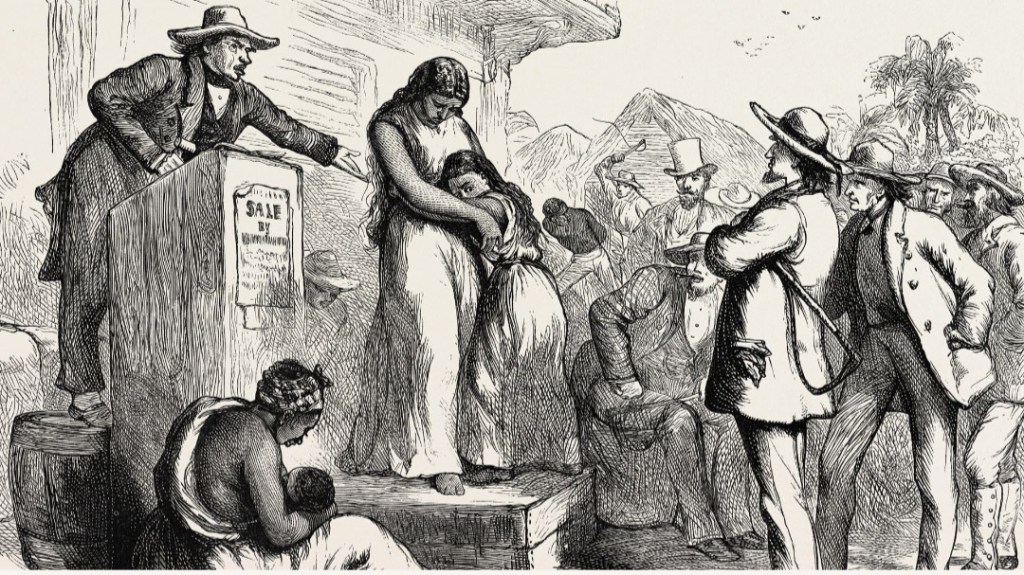
    When America declared its freedom, millions of Black Americans had none.

    That contradiction sits at the center of this holiday. It’s the tension between what America promised and what America practiced.


    The Legacy of Hypocrisy and Pain

    When “Freedom” Wasn’t Freedom for Everyone

    The Declaration of Independence spoke boldly of liberty, rights, and humanity — yet the same nation celebrating freedom legally enslaved Black people. Independence Day became a symbol of joy for some and a reminder of bondage for others.

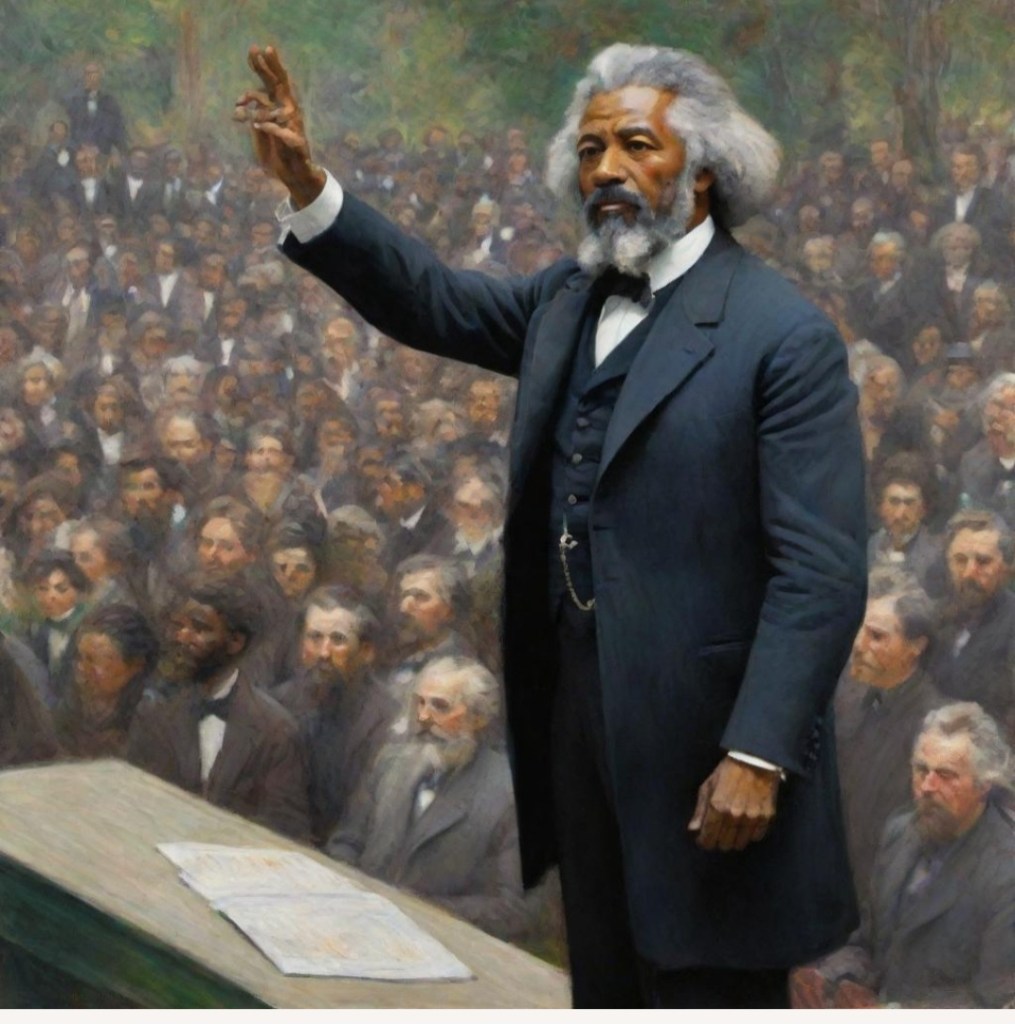
    Frederick Douglass captured this truth with surgical precision when he asked:

    “What, to the American slave, is your 4th of July?”

    He called the celebration an “inhuman mockery” — because how can a nation celebrate freedom while denying it to millions?

    July 4th was never just a holiday.
    It was a mirror — exposing the gap between America’s ideals and America’s reality.


    ✊🏾 How Black Americans Reclaimed the Fourth of July

    Turning a Day of Exclusion Into a Declaration of Our Own Freedom

    For generations, July 4th stood as a painful contradiction for Black Americans — a celebration of liberty in a land where they were denied it. But the story doesn’t end with hypocrisy. Over time, Black communities began to reclaim the holiday, reshaping it into a symbol of our struggle, our victories, and our ongoing pursuit of true freedom.

    Reclaiming Through Resistance

    Even while enslaved, Black Americans fought for the ideals the nation claimed to uphold. Their resistance — physical, intellectual, spiritual — became the truest expression of the Declaration’s promise.

    Reclaiming Through Celebration

    After emancipation, Black communities created their own July 4th traditions:

    • Parades led by Black veterans
    • Church services honoring freedom
    • Community feasts and festivals
    • Speeches demanding full citizenship

    These gatherings weren’t about imitation — they were about claiming space in a country built on their labor and sacrifice.

    Reclaiming Through Truth‑Telling

    Black leaders used July 4th as a platform to expose injustice and demand accountability.
    Truth became a form of reclamation — a way to force America to confront itself.

    Reclaiming Through Culture

    Music, food, fashion, storytelling, and community gatherings infused July 4th with Black joy, Black unity, and Black identity.

    Black Americans didn’t just reclaim the holiday.
    We expanded its meaning.
    We made it honest.
    We made it ours.


    Closing: If You’re Going to Celebrate This Day…

    Know What You’re Really Celebrating

    The Fourth of July isn’t just a date — it’s a story. A complicated one. A beautiful one. A painful one. A story built on courage, contradiction, and the ongoing fight to make freedom real for everyone.

    So if you’re going to celebrate this day, celebrate it with awareness.

    Celebrate the courage of those who fought for independence —
    but also acknowledge the millions who were denied it.

    Celebrate the ideals written in 1776 —
    but recognize the people who had to bleed, march, protest, and push this nation to live up to those ideals.

    Celebrate the fireworks
    but don’t forget the fire of Frederick Douglass’s words.

    Celebrate the progress
    but stay committed to the promise.

    Because the real meaning behind the Fourth of July isn’t just about what happened in 1776.
    It’s about what we choose to do with that truth today.

    If you’re going to celebrate this day, know what you’re really celebrating:

    • A nation still becoming
    • A freedom still expanding
    • A promise still unfolding
    • A story that includes everyone

  • Let’s Talk About Fatherhood

    ​A Father’s Day Conversation We Don’t Have Enough

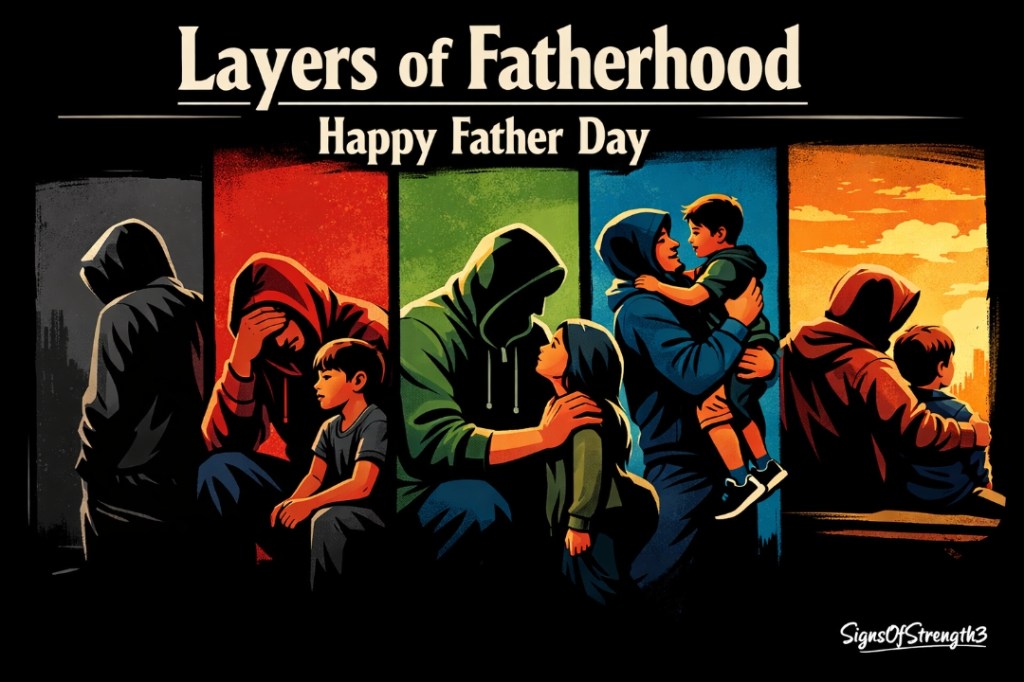
    Fatherhood is layered, emotional, complicated, and sacred. As Father’s Day comes around, men feel it in different ways — some with pride, some with regret, some with silence, and some with a heaviness they don’t talk about out loud. This day has a way of making men look back, not at the gifts or the cookouts, but at the choices they made… and the ones they didn’t.

    I’ve spoken with five men — some active fathers, some stepfathers, and some estranged from their children — and every single one admitted that Father’s Day hits differently. It exposes the gap between who they are and who they wanted to be. And that’s where this conversation begins.


    The Layers of Fatherhood

    Fatherhood isn’t one-dimensional. It’s a spectrum:

    • The biological father
    • The active father
    • The absent father
    • The stepfather who becomes the real father
    • The man who wants the title but not the work
    • The man who does the work but never gets the title

    Some men are fathers by blood.
    Some are fathers by heart.
    Some are fathers only by name.

    And the truth is, children know the difference.


    Why Some Men Get Labeled “Deadbeat”

    The term “deadbeat daddy” didn’t come from thin air. It came from patterns:

    • Men who disappear when responsibility shows up
    • Men who want praise without participation
    • Men who father children but don’t father lives
    • Men who leave the emotional and financial weight on the mother

    When a father doesn’t show up, the child pays the price — not the mother.
    And that’s why the label sticks.

    Why Your Role Matters

    A father shapes:

    • Identity
    • Confidence
    • Emotional stability
    • Discipline
    • Safety
    • Self-worth

    A father’s presence teaches a child how to love.
    A father’s absence teaches a child how to survive.

    Children don’t forget who showed up.
    They also don’t forget who didn’t.


    Why Some Stepfathers Become the Real Fathers

    Some stepfathers go harder than biological fathers ever did.

    Michael Sterling is a perfect example — he didn’t just “take on” a child.
    He claimed her.
    Loved her.
    Raised her.
    Protected her.
    And she became his daughter.

    Because fatherhood is not DNA.
    It’s devotion.

    Some men step up.
    Some men step back.
    And some men step away.


    Why Mothers Carry the Heavier Load

    Percentage-wise, mothers carry:

    • More physical responsibility
    • More emotional responsibility
    • More financial responsibility
    • More daily decision-making
    • More sacrifice

    Not because they want to.
    But because they have to.

    When fathers fall short, mothers stretch themselves thin.
    When fathers disappear, mothers double up.
    When fathers delay, mothers deliver.


    What the Bible Says About Fathers

    In Scripture, “father” means:

    • Source
    • Protector
    • Leader
    • Provider
    • Teacher

    The four core duties of a father:

    1. Provide — financially and emotionally
    2. Protect — physically and spiritually
    3. Guide — through discipline and example
    4. Model — character, integrity, and love

    Broken Father–Child Relationships: How to Rebuild

    Some fathers are estranged.
    Some are ashamed.
    Some don’t know where to start.

    Healing begins when pride ends.

    To rebuild:

    • Acknowledge the hurt
    • Take responsibility without excuses
    • Apologize without defending yourself
    • Be consistent, not convenient
    • Show up even when it’s uncomfortable
    • Give the child space to feel
    • Understand trust must be earned, not demanded

    Some fathers need to lower their wings — stop acting like they’re above accountability — and face the truth of their role in the distance.

    Why Some Stepfathers Outperform Biological Fathers

    Because they choose the child.
    Not out of obligation.
    Not out of guilt.
    But out of love.

    A stepfather often:

    • Shows up without being asked
    • Loves without conditions
    • Provides without reminders
    • Protects without hesitation
    • Builds without needing credit

    Some men father children they didn’t create.
    Some men create children they don’t father.

    How Fathers Can Be Better Moving Forward

    Growth starts with honesty.

    To be better:

    • Be present
    • Be consistent
    • Be accountable
    • Be teachable
    • Be emotionally available
    • Be financially responsible
    • Be a safe place
    • Be a leader, not a dictator

    Children don’t need perfection.
    They need effort.


    A Final Word on Fatherhood

    Fatherhood is not about perfection — it’s about presence. It’s about choosing to show up even when you weren’t shown how. It’s about breaking cycles you didn’t create but refuse to pass down. It’s about healing the boy inside you so you can raise the child in front of you.

    Some men are celebrating today.
    Some are grieving today.
    Some are reflecting today.
    Some are rebuilding today.

    And some are finally ready to admit:

    “I could’ve done better. I still can.”

    Fatherhood is a journey — not a moment.
    A responsibility — not a title.
    A legacy — not a holiday.

    Whether you’re a biological father, a stepfather, a spiritual father, or a man trying to find his way back — your role matters more than you know.

    A Prayer for Fathers

    Father God,
    Today we lift up every man wearing the weight of fatherhood — the proud ones, the broken ones, the distant ones, and the ones trying to find their way back. Strengthen the men who are doing the work. Heal the men who are hurting. Restore the men who feel disconnected from their children. Give them courage to apologize, humility to rebuild, and wisdom to lead with love.

    Cover every child who longs for their father’s presence.
    Cover every mother carrying more than her share.
    Cover every stepfather who stepped in with a full heart.
    And cover every man who desires to be better than he was yesterday.

    Lord, teach fathers to protect, provide, guide, and love the way You do — with patience, with grace, and with consistency.
    Let healing begin where silence once lived.
    Let restoration begin where pride once stood.
    And let love rewrite every story that started with pain.

    Amen.

  • When Words Become Weapons: Verbal Abuse & Mental Abuse

    LET’S TALK ABOUT IT

    Some people think abuse only counts when there are bruises.
    But the truth is this: the tongue can bruise a spirit just as deeply as a fist can bruise skin.

    Verbal abuse is abuse.
    Mental and emotional abuse are abuse.
    And the two often walk hand‑in‑hand.

    In my classes, you learn a lot as you grow.
    A lot of women put up with this daily, and some make excuses for men’s behavior — I see it all the time.
    Let’s talk about it.


    Verbal Abuse Looks Like

    • name‑calling
    • cursing at you
    • insults
    • belittling
    • yelling meant to intimidate
    • words used to shame or control

    When someone calls you “bitch,” “motherf***er,” “stupid,” “crazy,” or any degrading name —
    that is verbal abuse, not “just anger,” not “just how they talk.”


    Mental/Emotional Abuse Looks Like

    • manipulation
    • gaslighting
    • silent treatment
    • blame‑shifting
    • minimizing your feelings
    • making you question your worth
    • creating fear, confusion, or instability

    Verbal abuse is one of the tools emotional abusers use.
    They are not separate — they are connected.


    Let’s Be Honest

    What people call “normal arguing” is often dysfunction.
    Healthy conflict doesn’t require tearing someone down.
    Healthy love doesn’t require destroying someone’s identity.
    Healthy communication doesn’t require humiliation.

    And let’s be clear:
    If someone reacts defensively when you talk about abuse,
    it’s usually because the truth hit closer than they want to admit.


    My Truth

    Me myself was never physically abused,
    but my ex‑husband tried to verbally abuse me and I was not going for it.
    So then I was labeled like I wanted to be the man,
    like I was “hard,”
    because I would not tolerate his behavior.

    One of my things I don’t tolerate is being disrespected. I hate it.
    Some women only make it worse because they fear to speak up.

    But here’s the truth:

    A woman who refuses abuse is not hard — she is healthy.
    A woman who sets boundaries is not masculine — she is wise.
    A woman who won’t tolerate disrespect is not controlling — she is protecting her spirit.


    Scripture to Strengthen You Through This

    Proverbs 12:18 — reckless words pierce like a sword
    Ephesians 4:29 — let no corrupt communication come out of your mouth
    Colossians 3:19 — do not be harsh

    Harshness is not love.
    Disrespect is not love.
    Verbal violence is not love.


    You Deserve Safety

    You deserve safety — emotionally, mentally, and verbally.
    Don’t let anyone convince you otherwise.
    Don’t let anyone minimize what you lived through.
    Don’t let anyone tell you abuse “doesn’t count” unless it leaves a mark.

    Your spirit is worth protecting too.


    A Prayer for Anyone Healing From This

    God, heal every unseen wound.
    Restore every place where words broke confidence, identity, or peace.
    Give strength to walk away from what harms,
    and courage to walk toward what is healthy, whole, and honoring.
    Cover every heart that has been bruised by the tongue,
    and remind them they are worthy of love that does not wound.
    Amen.


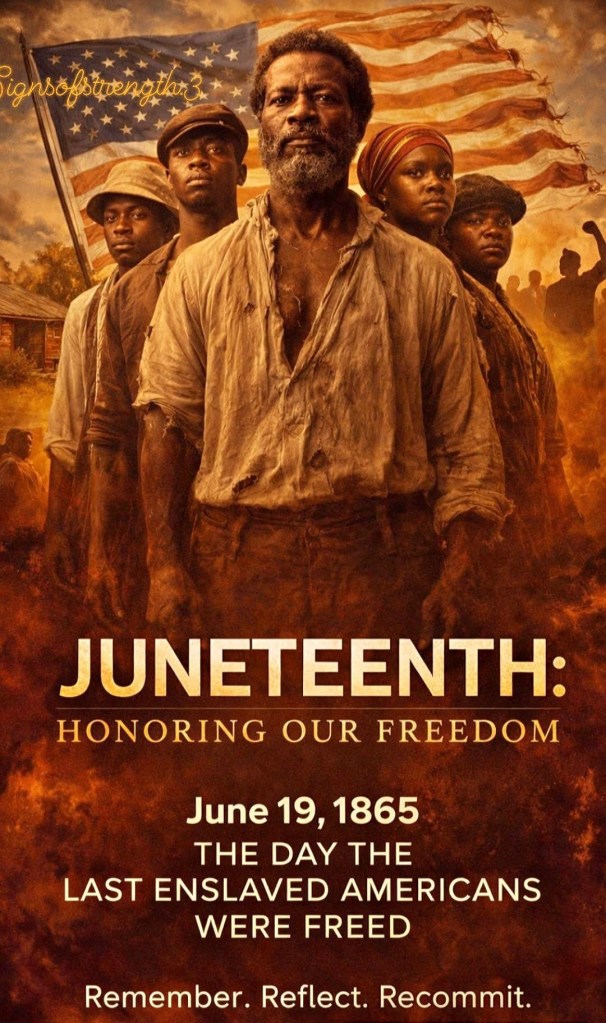
  • Honoring Juneteenth

    Freedom didn’t arrive all at once — but when it came, it changed everything.

    Today we remember June 19, 1865, the day the last enslaved men and women in Galveston, Texas finally heard the words that should have reached them years earlier:

    You are free!!!!!!!!!!!!!!!!!!!!!!!!!!

    Juneteenth is more than a date.It is a testament to resilience, a celebration of survival, and a call to continue the work our ancestors began.

    We remember their struggle.We reflect on their strength.We recommit to their legacy.

    May we honor them not only with celebration, but with action — in our communities, in our families, and in the way we show up for justice, dignity, and each other.

  • Black & White: Dating — Who Gets to Decide?


    Let’s Talk About It:

    Every time a Black man or Black woman dates outside their race, the internet turns into a town hall meeting nobody scheduled. Suddenly everybody has an opinion — even the people who swear they “don’t care.” Folks start projecting, debating, judging, and acting like love needs community approval before it can exist.

    But here’s the real question:

    Who actually gets to decide who someone loves — the person, or the people watching?

    Because the truth is simple:
    People date for connection.
    The internet reacts from emotion.
    And somewhere in the middle, the conversation gets messy.

    And let’s be clear — this isn’t about being racist.
    This is about culture, history, and the way certain choices hit old wounds we don’t always talk about.


    The Narrative vs. The Reality

    People love to throw out the same tired lines:

    “Black women are too strong.”
    “Black women got attitudes.”
    “Black women don’t submit.”

    But that’s not the real story — that’s the shortcut.

    Here’s what’s actually going on:

    • It’s not about Black women — America labels Black femininity as “too much” and white femininity as “soft.” That’s perception, not personality.
    • Success changes the pressure — Some Black men feel like dating a white woman signals status because this country taught them whiteness = elevation.
    • People project their insecurities — When a Black man dates outside his race, folks assume it’s a rejection of Black women, even when it’s not.

    None of this is about Black women being “too strong.”
    It’s about how America reads strength when it’s on a Black woman.


    Why Black & White Dating Still Sparks Reactions

    When a Black man dates outside his race — especially when he’s successful — it hits nerves:

    • History — Black men were once punished for even looking at white women, while Black women were ignored or erased.
    • Loyalty — Some Black women feel like, “We held you down… and now success means choosing someone else.”
    • Visibility — Black women are often overlooked in media and dating spaces, so it stings deeper.

    So when a successful Black man chooses a white woman, it doesn’t feel like “just dating.”
    It feels symbolic — even if he didn’t mean it that way.


    Where Dr. Umar Fits Into This Conversation

    Dr. Umar Johnson is a well‑known Pan‑African psychologist who believes that marriage is a political act, not just a romantic one. He argues that when Black men marry outside their race, it weakens the collective strength of the Black community.

    Whether people agree with him or not, he has become a symbol in these conversations.

    That’s why every time a Black man dates a white woman — especially a successful one — the internet jokes:

    • “Somebody check on Dr. Umar.”
    • “Dr. Umar punching the air right now.”
    • “Don’t let him see this.”

    It’s not really about him.
    It’s about what he represents:

    • Protection of Black love
    • Fear of cultural loss
    • Historical trauma
    • Community loyalty

    He’s become the internet’s shorthand for the deeper tension people feel — the tension that shows up every time interracial dating hits the timeline.


    Why Interracial Dating Still Explodes Online

    Every time an interracial couple hits the timeline — celebrity or not — the internet acts like it’s been personally invited to judge, debate, and dissect the relationship. It doesn’t matter if it’s Jamie Foxx announcing a baby, a TikTok couple posting a dance, or a random photo going viral. The reaction is instant, emotional, and loud.

    Why?
    Because interracial dating isn’t just about two people.
    Online, it becomes a symbol — a trigger — a cultural flashpoint.

    Here’s what really makes it explode:

    • People react to the history, not the couple
    • Everyone brings their own wounds
    • Social media rewards outrage
    • Interracial dating exposes insecurities
    • It challenges the idea of “ownership” in the Black community

    So when Jamie Foxx made his announcement, it wasn’t him that caused the explosion — it was everything people already felt, carried, and feared.

    He was just the spark.
    The fire was already there.


    The Viral Post Everyone’s Talking About

    Recently, a headline started circulating online claiming that a group of white women were “coaching each other” on how to secure Black athletes. The post went viral instantly — not because people knew the full story, but because the headline hit every emotional trigger at once.

    It stirred up:

    • Old fears
    • Old wounds
    • Old stereotypes
    • Old narratives

    Whether the story was true, exaggerated, or taken out of context didn’t even matter — the headline alone was enough to set the internet on fire.

    These viral posts don’t create the tension.
    They expose the tension that’s already there.


    When Black Women Date White Men — The Double Standard

    Here’s the part people pretend not to see:
    Black women get attacked too when they date white men. And the criticism hits different — not because of who they’re dating, but because of what people think it means.

    People start assuming:

    • “She gave up on Black men.”
    • “She thinks she’s better now.”
    • “She only wants a white man for stability.”
    • “She’s trying to level up.”

    But most Black women who date outside their race aren’t making a political statement.
    They’re choosing someone who treats them well.

    So why does it spark so much noise?

    Because it touches:

    • Ownership
    • Expectations
    • Projection
    • Visibility

    When Black men date white women, people call it a “pattern.”
    When Black women date white men, people call it a “betrayal.”

    Same situation.
    Different judgment.
    Same double standard.

    Black women deserve the same freedom everyone else has:
    the freedom to choose love without being punished for it.


    What the Bible Actually Says About Interracial Dating

    Let’s clear this up, because people love to throw the Bible into conversations it was never confused about.

    The Bible does not condemn interracial dating or interracial marriage.
    Not once.
    Not anywhere.

    Here’s what Scripture does emphasize:

    Spiritual compatibility matters more than skin color
    When the Bible talks about being “unequally yoked,” it’s talking about faith, not ethnicity.
    It’s saying:
    Don’t build a life with someone who doesn’t share your spiritual foundation.

    That’s about belief — not race.

    God looks at character, not ethnicity
    From Genesis to Revelation, the focus is always on:

    • the heart
    • the character
    • the fruit of someone’s life
    • the alignment of values

    Not the shade of their skin.

    The Bible actually includes interracial marriages
    People forget this part:

    • Moses married a Cushite woman — and when his family criticized it, God checked them, not him.
    • Boaz married Ruth, a Moabite woman — and their lineage leads straight to King David and Jesus.

    If interracial marriage was a sin, Jesus Himself would not come from a multi‑ethnic bloodline.

    So no — interracial dating is not unbiblical.
    What’s unbiblical is using Scripture to justify personal discomfort.


    So Who Gets to Decide?

    At the end of the day, the answer is simple:

    The people in the relationship.
    Not the internet.
    Not the community.
    Not the comments.

    People are allowed to love who they love.
    And the community is allowed to feel what it feels.

    Both can exist at the same time.

    This isn’t about hating anybody.
    This isn’t about racism.
    This is about culture, history, and the way certain choices hit nerves that were formed long before social media existed.

    What matters is that we talk about it honestly — without stereotypes, without shortcuts, and without pretending the reactions come from nowhere. Because when we understand the roots, the conversation gets clearer, softer, and a whole lot more real.

    And that’s why we’re here.
    To talk about it.
    To unpack it.
    To understand it.


    Closing Word

    May we all learn to love with clarity, not confusion.
    With honesty, not fear.
    With understanding, not assumptions.


    Closing Prayer

    God, give us the wisdom to see people the way You see them —
    beyond color, beyond culture, beyond assumptions.
    Teach us to love with clarity, not confusion.
    To honor history without letting it harden our hearts.
    To choose connection without fear, and truth without judgment.
    Cover our families, our communities, and our conversations
    as we navigate topics that are bigger than us
    but necessary for all of us.
    Amen.

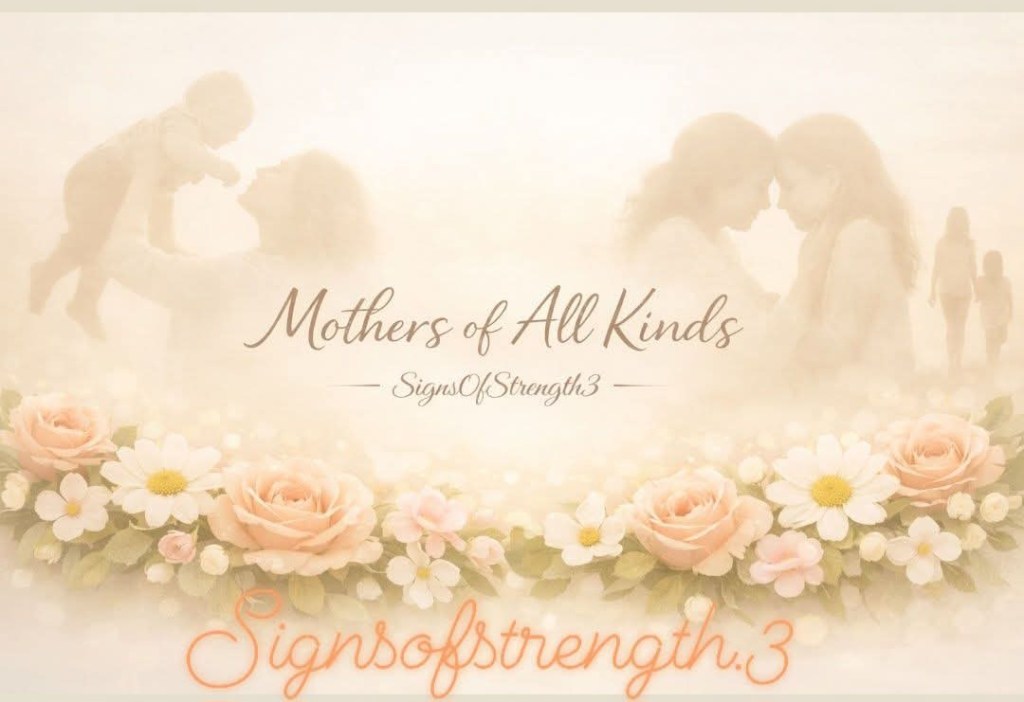
  • Mothers of All Kind


    Let’s Talk About It

    A mother is fundamentally defined as a female parent — but anyone who has lived life knows it’s deeper than that.

    A mother is a nurturer.
    A giver.
    A protector.
    A teacher.
    A safe place.
    A woman who pours out pieces of herself so someone else can grow.

    Beyond biology, a mother is defined by her actions — the sacrifices nobody sees, the love that doesn’t run out, the guidance that shapes a child’s life long before they understand it.

    Happy Mother’s Day.

    My mom is no longer here with me. And this weekend always brings a mix of love, memory, and longing. I miss her every single day. Her love shaped me. Her strength raised me. Her absence still teaches me.

    So today, I’m dedicating this post to all kinds of mothers — the ones we had, the ones we needed, the ones we lost, the ones we’re still becoming.

    Motherhood is not one story. It’s many. And every story deserves to be honored.


    The Beginning:

    When Motherhood First Happens

    Motherhood doesn’t start with perfection. It starts with a moment — a shift — a quiet realization that life will never be the same again.

    It begins long before a child understands anything about love, sacrifice, or responsibility. It begins in the heart of a woman who suddenly carries more than her own life.

    Motherhood starts with the shock, the joy, the fear, the responsibility, and the weight of knowing someone now depends on you.

    No one prepares you for the emotional cost. No one explains how your identity stretches, shifts, and reshapes itself. No one tells you that you will lose parts of yourself and find new ones at the same time.

    Love becomes duty.
    Strength becomes required.
    Sacrifice becomes a rhythm.

    Motherhood begins in the quiet, unseen moments — the ones that shape a woman long before her child ever realizes it.


    The Middle: The Sacrifice Years

    If the beginning of motherhood is a shift, the middle is a sacrifice.

    These are the years where a mother gives and gives and gives — often without a thank you, often without a break, often without anyone noticing how much she’s carrying.

    These are the years of sleepless nights, early mornings, long days, and endless responsibilities.

    She works.
    She cooks.
    She cleans.
    She comforts.
    She teaches.
    She protects.
    She holds the house together.
    She holds the family together.
    She holds herself together — even when she’s falling apart inside.

    Dreams get paused.
    Identity gets blurry.
    Her own needs get buried under everyone else’s.

    Most of this work is invisible.
    Most of this work is unspoken.
    Most of this work is taken for granted.

    But these sacrifice years are where a mother’s love is proven — not by perfection, but by presence.


    The Hard Truth: When They Grow Up

    There comes a moment no one prepares a mother for — when the child she raised becomes an adult, and the relationship shifts.

    You can raise them, love them, protect them, sacrifice for them, pour your whole soul into them… and still watch them grow up and forget what it took to get them there.

    This is the quiet heartbreak many mothers carry:

    The unappreciated.
    The overlooked.
    The ones who gave everything and got silence.
    The ones whose children remember the mistakes but not the sacrifices.
    The ones healing from the very people they raised.

    Love doesn’t always return the way it was given.
    Sacrifice doesn’t always get acknowledged.
    Presence doesn’t always get remembered.

    But even in that truth, a mother’s heart keeps loving, hoping, praying, and showing up in the ways she can.

    Real love leaves fingerprints — even when the world forgets who made the mark.


    The Mothers of All Kinds

    Motherhood has never been one story. It has always been many.

    This layer is for every kind of mother, including the ones often forgotten:

    The good mothers — who loved deeply and showed up consistently.
    The complicated mothers — whose love was real but tangled in their own struggles.
    The healing mothers — who decided the pain stops with them.
    The imperfect mothers — who made mistakes but kept trying.
    The overlooked mothers — who carried the weight quietly.
    The mothers who did their best with what they had — even when it wasn’t much.
    The mothers who didn’t know how to love because nobody taught them — but still tried.
    The mothers who carried the weight alone — emotionally, financially, spiritually.
    The mothers whose children grew up and forgot the cost — but still love them anyway.

    Motherhood is layered.
    Human.
    Sacred.
    Flawed.
    Beautiful.
    Painful.
    Powerful.

    Every mother deserves to be seen.


    The Legacy :

    Every mother leaves something behind — a lesson, a pattern, a wound, a strength, a story.

    Legacy is not just what a mother gives her child. It’s what a child carries forward.

    Some of us became the mother we needed.
    Some became the mother we never had.
    Some are still becoming the mother we wish we’d known.

    Legacy is found in the habits we break, the cycles we refuse to repeat, the love we give differently, the boundaries we learn to set, the healing we choose, the forgiveness we grow into, the strength we pass down, and the softness we reclaim.

    Legacy is not perfection — it’s intention.

    “This ends with me.”
    “This begins with me.”

    Their story becomes our starting point.
    Their strength becomes our foundation.
    Their mistakes become our lessons.
    Their love — in whatever form it came — becomes our reminder that we are here because someone tried.

    Legacy is not just what they left us.
    It’s what we choose to carry forward.


    The Grief :

    : For the Ones Who Are Hurting

    Mother’s Day is beautiful for some… but for others, it aches.

    This is for the ones who lost their mother, their grandmother, the woman who raised them, the mother they were healing with, or the mother they were just beginning to understand.

    Grief rises in memories, in silence, in the moments you wish you could hear her voice again.

    Mother’s Day can feel like a reminder of what’s missing, what you didn’t get to say, and the love you still carry with nowhere to place it.

    But even in the weight of it all, grief does not get to win.

    You will still celebrate.
    You will still smile.
    You will still honor the woman who shaped you.

    Grief may visit… but joy still has a home here too.

    If you’re hurting this weekend — you are not alone.
    Your love is valid.
    Your sadness is real.
    Your memories matter.


    The Blessing + Prayer

    May this Mother’s Day meet every woman exactly where she is.

    To the joyful — may your joy multiply.
    To the tired — may strength rise again.
    To the unseen — may heaven remind you your sacrifices were witnessed.
    To the grieving — may comfort wrap around you gently.
    To the ones who did their best — may grace find you.
    To the ones who raised children alone — may God restore what you poured out.
    To the healing — may this be the year your heart breathes easier.
    To the imperfect — may forgiveness flow both ways.
    To the mothers who lost children — may God hold your heart tenderly.

    To every woman who has ever carried, nurtured, protected, guided, or loved — you are a mother in the truest sense.

    May God strengthen your hands.
    May He restore your joy.
    May He heal your heart.
    May He honor your sacrifices.
    May He surround you with love that lifts and sustains you.
    May this Mother’s Day remind you that you matter — deeply.

    Amen.

  • .


    🍲 When Mama Tina’s Gumbo Went Viral — And What It Revealed About Us

    Let’s Talk About It…

    Gumbo originated in 18th‑century Louisiana as a culinary fusion of West African, Native American, and European traditions. It was created by enslaved people and working‑class residents who took what little they had and turned it into something that could feed everybody.

    The word itself comes from the Bantu word for okra — ki ngombo — a reminder that gumbo is rooted in African heritage long before it ever became a Louisiana staple.

    The dish began as an economical stew, made from whatever ingredients were available — shellfish, game, smoked meats, okra, or whatever the land provided. Early versions leaned heavily on okra, but over time gumbo evolved into the two styles we know today:

    Cajun gumbo: darker roux, no okra, no tomatoes
    Creole gumbo: tomato‑based, often with okra

    In other words, gumbo has always changed.
    It has always adapted.
    It has never had just one “right” way.


    The Mama Tina Moment

    So when Mama Tina Knowles brought her gumbo to the Houston Rodeo and the internet exploded with criticism, it revealed something deeper than taste preferences.

    It exposed how quick we are to gatekeep culture, identity, and tradition — even when the tradition itself was born from blended cultures, shared struggle, and survival.

    And let’s be honest — everybody thinks they make the best gumbo.
    I make vegan gumbo and I think mine is the best.
    You probably think yours is the best.
    Your auntie thinks hers is undefeated.
    Your cousin swears by his roux.

    We all have different taste, different hands, different traditions.
    So who gave anybody the right to say, “That’s not Louisiana gumbo”?

    Because truth be told…
    I’ve had gumbo in Louisiana that was horrible.
    And I’ve had gumbo outside Louisiana that tasted like somebody’s grandmother was whispering over the pot.

    So if gumbo can taste different in the very place people claim it “belongs,”
    why are we acting like there’s only one right way to make it?


    The Gumbo of Our Lives

    And that’s when I realized something deeper:

    People treat life the same way they treat gumbo.

    Everybody thinks they know the “right” way to live.
    Everybody thinks their version is the best.
    Everybody thinks their ingredients are the only ones that count.

    But life — just like gumbo — is personal.
    It’s cultural.
    It’s generational.
    It’s spiritual.
    It’s messy.
    It’s mixed.
    It’s yours.

    When I look at my own life, I see gumbo all through it.

    I raised two daughters as a single mother.
    I dated here and there, but nothing serious — because my focus was being a mom.
    My oldest daughter’s dream became our family rhythm.
    Rehearsals. Performances. Studios. Stages.
    That was our life. That was our gumbo.

    I poured everything into my children.
    My time.
    My energy.
    My identity.
    My womanhood.

    And when my oldest left for college, I had to face a truth I wasn’t ready for:

    I didn’t know who I was outside of being “Mom.”

    But gumbo teaches us something powerful:

    You can always start a new pot.
    You can always add new ingredients.
    You can always change the recipe.
    You can always begin again.

    And that’s not just my story —
    that’s our story.


    Traditions — And the Right to Change Them

    Gumbo may be a tradition — but not all traditions are sacred.
    Some were painful.
    Some were rooted in survival, not celebration.
    Some were passed down without questioning whether they still serve us.

    Tradition refers to the handing down of customs, beliefs, and practices from one generation to another.
    It represents established, repeated behaviors — holidays, ceremonies, rituals — that provide continuity and cultural identity.

    But here’s the truth:

    Not all traditions deserve to be preserved.
    Some deserve to be healed.
    Some deserve to be reimagined.
    Some deserve to be carried forward in a new way — in your own family, in your own voice, in your own pot.

    Just like gumbo, traditions can evolve.
    They can get better.
    They can be changed.
    They can be reclaimed.


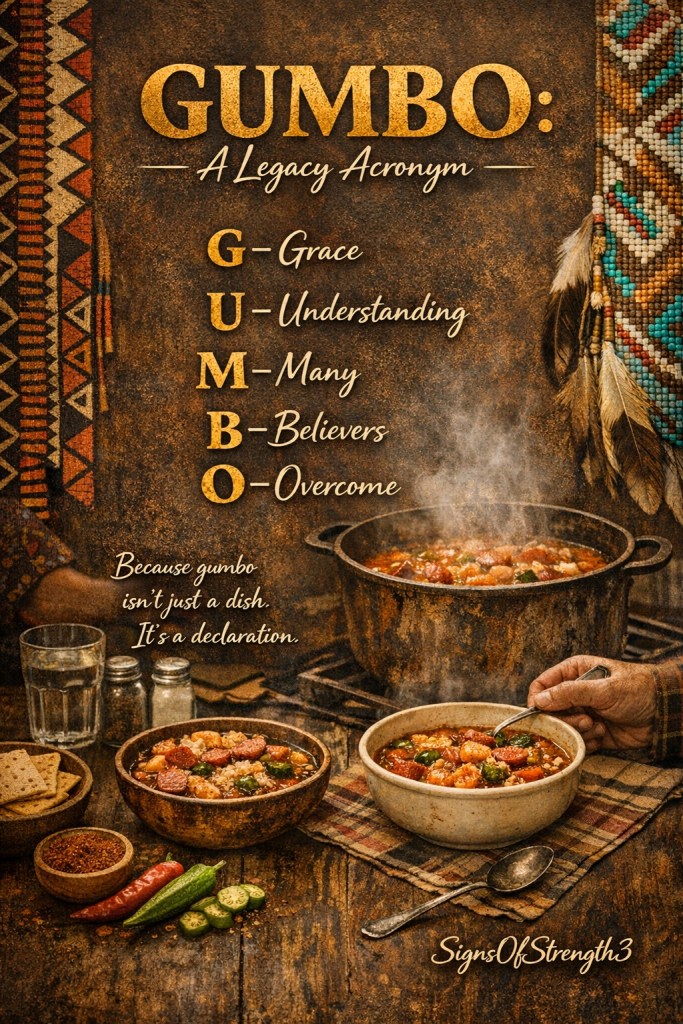
    GUMBO: A Legacy Acronym

    G — Grace
    U — Understanding
    M — Many
    B — Believers
    O — Overcome

    Because gumbo isn’t just a dish.
    It’s a declaration.


    Scripture of the Week

    “For I know the plans I have for you,” declares the Lord,
    “plans to prosper you and not to harm you,
    plans to give you hope and a future.”
    — Jeremiah 29:11

    Even when life feels mixed, messy, or uncertain —
    God is still stirring the pot.


    Prayer

    Father, thank You for the gumbo of our lives — the mix of joy, pain, culture, sacrifice, and strength that shaped who we are.
    Teach us to honor every ingredient, even the ones we didn’t choose.
    Help us release the pressure to live life one “right” way and embrace the unique recipe You’ve given each of us.
    Stir up new purpose, new identity, new confidence, and new love within us.
    Bless every woman reading this with clarity, courage, and the boldness to begin again.
    Amen.


    Call to Action: Let’s Stir the Pot Together

    This week, honor one ingredient in your life that you used to overlook.

    Maybe it’s your resilience.
    Maybe it’s your creativity.
    Maybe it’s your motherhood.
    Maybe it’s your healing.
    Maybe it’s your voice.

    Write it in your journal or drop it in the comments:

    “This is part of my gumbo — and I’m proud of it.”

    Because gumbo belongs to the people.
    And your life belongs to you.

  • Let’s Talk About It: When Excellence Still Isn’t Enough

    It’s been one week since the Oscars, and I’m still thinking about what we all watched — not the gowns, not the speeches, but the message underneath the whole night. The part we keep pointing out. The part that keeps coming back no matter how many times we call it out.

    And the truth is, people have been speaking out about this for years. Directors, actors, critics, fans — everybody sees the pattern. It’s a fight we keep bringing up because it keeps showing up. Spike Lee has been calling it out for decades, long before social media had the language for it. And yet here we are again, watching the same story play out in real time.


    And Here We Are Again

    We can be excellent, and still questioned.

    We can be first, and still overlooked.

    We can be groundbreaking, and still expected to “prove it again.”

    We can be talented, and still judged harsher when we slip.

    And that’s the part we keep bringing up — because it keeps happening.


    Why the Best Picture Win Doesn’t Always Follow

    Across multiple years, critics and industry insiders point to three recurring reasons:

    • Politics inside the Academy — long‑standing voting blocs, generational divides, and internal biases shape outcomes more than people realize.

    • “Safe” choices vs. bold art — the Academy often gravitates toward films that feel familiar or less risky, even when another film is clearly stronger in craft, storytelling, or cultural impact.

    • Campaign power — studios with bigger budgets, louder marketing, and stronger influence often sway voters more effectively than the films that actually delivered the best work.

    And that’s why you’ll see a film sweep technical categories and writing…
    but lose Best Picture to something more “comfortable” for the voting body.

    A recent example mirrors the pattern:
    In 2026, One Battle After Another won Best Picture, even though the race was tight and another film (Sinners) was equally deserving and winning major categories. The final outcome reflected industry politics and preference, not just craft.

    That’s exactly the kind of inconsistency Spike Lee has been calling out for decades — not because it’s about one group or one moment, but because it’s a pattern baked into the system itself.


    And Then the Night Took a Turn — Because Golden Hit the Stage

    Let’s be real: the performance wasn’t strong.
    Every singer can’t sing live, and that moment showed it.

    But here’s what caught my attention — not the vocals, but the reaction.

    Some people online were calling it “vulnerable” and “real,” almost like the lack of polish made it more artistic. A few even compared it to the raw emotion you see in some K‑Pop stages.

    And listen… that’s fine.
    Everybody’s allowed to enjoy what they enjoy.

    But let’s not pretend we don’t see the difference in how people respond depending on who is on that stage.

    Because if certain artists had delivered that same level?

    The internet would’ve been on fire.
    Memes. Threads. Think‑pieces.
    People would’ve been dragging them before the mic cooled off.

    But that night?
    Silence.
    Soft takes.
    Gentle excuses.

    That silence said everything.


    This Part Hits Home for Me

    My daughter is in this business, and it’s not easy.
    She sings beautiful songs, she acts, she performs — she’s a star in her own right.
    But she still has to work ten times harder just to be seen.

    She doesn’t get the luxury of a bad night.
    She doesn’t get to go viral for doing something silly or off‑key.
    She has to be polished, prepared, and consistent in ways others don’t.

    She’s already in these rooms.
    She’ll be around these people.
    And one day, she’ll be at the Oscars or the Grammys herself — standing on those same stages, delivering excellence the way she always has.

    But the path she has to take to get there?
    It’s steeper.
    It’s louder.
    It’s judged more harshly.

    And that’s why this whole conversation matters to me on a different level.

    The Heart of the Piece

    We as Black Americans come so far, but yet we are still fighting and have to prove ourselves.
    And that’s the heart of this whole piece.

    Because this isn’t about music.
    This isn’t about the Oscars.
    This is about the pattern across every industry:

    • We can be excellent, and still questioned.
    • We can be first, and still overlooked.
    • We can be groundbreaking, and still expected to “prove it again.”
    • We can be talented, and still judged harsher when we slip.

    This is a truth many people feel but don’t say out loud.


    Reflective, Honest, and Thoughtful

    So will it get better? Maybe.
    But here’s what I know for sure:

    Every time we speak on these patterns, somebody calls it “complaining.”
    Every time we point out the inconsistency, somebody says we’re “making everything about race.”

    But deep down, everybody knows exactly what it is — they just won’t all admit it.

    And that’s why we keep talking.
    That’s why we keep calling it out.
    Not because we want to argue, not because we’re looking for a fight, but because silence never protected anyone anyway.

    We’ve come too far, worked too hard, and broken too many ceilings to pretend we don’t see what we see.

    And if speaking the truth makes some people uncomfortable…
    that’s a them problem, not ours.


    What We Know for Sure

    “Excellence has never been our problem — being seen for it has.
    And we don’t speak up to complain; we speak up because silence never changed a thing.”

    God, give us the courage to speak truth with grace, the wisdom to see beyond what shines, and the strength to keep showing up even when recognition falls short. Cover every artist, every child, and every dreamer who feels unseen. Remind us that You measure what the world overlooks. Amen.

  • Footprints: The Steps We Take, The Legacy We Leave

    Let’s Talk About It

    The Meaning of a Footprint

    Our feet are not simply the pedestals on which we stand or the motors by which we move. They are the foundations of our presence in the world. Every footprint we leave behind carries a message — a blend of our humanity and the divine imprint of the One who guides our steps. Some prints show where we’ve struggled, some show where we’ve grown, and some reveal the quiet places where God carried us when we couldn’t carry ourselves.

    For years, I never paid attention to how powerful a footprint really is. But the more I studied, the more I realized: our feet tell the truth about our journey. They tell the truth about our ancestors’ journey too. Some of them walked far. Some of them stood firm. Some of them never made it to the places they dreamed of — but their standing became the ground we now walk on.

    A footprint is never just a mark in the dirt. It is evidence of existence. Evidence of endurance. Evidence of purpose.

    What a Footprint Really Is

    A footprint is the impression left by a foot or shoe on a surface. But spiritually and symbolically, it is so much more. It is the path we choose. It is the weight we carry. It is the impact we leave behind. It is the story our life is telling.

    Some people believe their feet took them far. Others are still standing in the same place — but even standing is a form of strength. Even standing leaves a mark.

    When you think about it, our feet are powerful. They carry our purpose, our pain, our progress, and our prayers. They carry the parts of us we show the world and the parts we hide. They carry the dreams we’re chasing and the burdens we’re trying to release.

    Our footprint is the proof.

    The Footprints of Our Ancestors

    Our ancestors left their footprint long before we took our first step. Their footprints weren’t just physical — they were emotional, cultural, spiritual.

    Footprints of survival.
    Footprints of sacrifice.
    Footprints of faith.
    Footprints of prayers whispered over generations.

    We are walking in paths they carved, carrying dreams they never got to finish, and living in answers to prayers they prayed.

    Their footprints didn’t end.
    They extended into us.

    The Footsteps of Those Who Came Before Us

    When I think about the power of a footprint, I can’t help but think about our ancestors — especially those who survived slavery. Many of them had nothing but their feet. No transportation. No protection. No freedom. No guarantee of tomorrow.

    All they had was the strength to run, the courage to walk, and the will to keep moving.

    Their feet carried:
    chains
    hope
    fear
    prayers
    survival
    determination

    Some ran toward freedom.
    Some walked through pain.
    Some stood their ground when standing was all they could do.

    And every one of them left a footprint behind — a mark that says, “I was here. I endured. I survived. I mattered.”

    Those footprints didn’t disappear.
    They became the path we walk today.

    The Legacy of a Footprint

    Tyler Perry once said he is living his footprint — and he has created so many millionaires that his steps will be remembered long after he’s gone. That’s the power of a footprint. It’s not about fame. It’s about impact. It’s about who rises because you walked.

    Some people leave footprints that build bridges.
    Some leave footprints that break generational curses.
    Some leave footprints that open doors for others.

    Footprints are not always loud.
    Sometimes they are quiet, steady, faithful steps that change everything.

    The Footprints Our Children Leave

    Just as our ancestors left their mark, our children are leaving theirs too.

    Some footprints are made over a lifetime, and some are made early — long before the world expects them. My oldest daughter is one of those souls whose steps have always carried purpose. At a young age, she began leaving footprints that stretched farther than her age, her size, or her circumstances.

    She was the first Black girl to win School of Rock All Star in Sugar Land, and that alone carved a path no one had walked before her. She didn’t just perform — she shifted the room. She is actively leaving her mark on the theater community — every role she steps into becomes a footprint they still talk about.

    And she didn’t stop there — she’s still going.

    She continues to leave her footprint in theater with every role she steps into. She has taken on so many impressive characters, including playing Ariel in The Little Mermaid — a role that lit up the stage and showed everyone exactly who she is. And she is still being cast, still performing, still growing, and still building a path that is uniquely hers.

    She became President of the Student Alliance, a leader whose voice carried weight, compassion, and courage. She will graduate college with a legacy already established — not because she tried to be impressive, but because she walked with intention. Every stage she stepped on, every room she entered, every challenge she faced… she left a footprint.

    A footprint of excellence.
    A footprint of resilience.
    A footprint of representation.
    A footprint of faith.

    She became a top winner at the NAACP, adding yet another mark to a path she is still building. And the beauty of it all is this: she is still young, still growing, still becoming — yet her footprints already speak loudly.

    Some people spend a lifetime trying to leave a legacy.
    Some children are born with one in their feet.

    The Footprints Still Forming

    Not every footprint is loud. Not every footprint is fully shaped yet. Some are still forming.

    My youngest daughter is discovering her own steps — learning who she is, what she carries, and what path she wants to walk. Her footprint is gentle right now, but it’s growing stronger every day.

    And my son… he slipped off his path for a moment. Life will do that. But I believe in the power of a returning step. I believe in the strength of a footprint regained. He is fighting his way back, and when he does, his story will leave a footprint worth remembering.

    Some footprints are early.
    Some are steady.
    Some are lost and found again.
    But all of them matter.

    Why One Step at a Time Matters

    And now I understand why people say, “Just keep putting one foot in front of the other.” It’s not just a motivational quote — it’s a survival strategy.

    It’s a reminder that progress doesn’t always come in leaps. Sometimes it comes in slow, steady, intentional steps. Sometimes it comes in the days when you don’t feel strong, but you move anyway. And sometimes it comes in the seasons where standing still is the bravest step you can take.

    We don’t always realize how important our feet are — not just physically, but spiritually and historically. Our feet carry our entire story. They carry our weight, our wounds, our victories, our faith, and our future.

    Every step mattered.

    The Footprint I’m Learning to Leave

    And here’s where my truth comes in.

    I’m guilty. For years, my objective was to push my oldest daughter to become everything I wasn’t. To be better. To go farther. To win where I had lost. I wasn’t trying to control her — I was trying to redeem the parts of myself I thought were too broken, too late, or too far gone.

    But life has a way of humbling you.

    I made bad decisions. I got stuck in my own way. I lost time I can’t get back. But I never gave up. And somewhere in the middle of all that stumbling, I realized something important:

    Growth doesn’t come from perfection.
    Growth comes from refusing to stay stuck.

    I can’t rewrite my past, but I can shape my footprint. I can leave a mark that my youngest daughter can stand on. I can walk in a way that shows her what strength looks like, what healing looks like, what accountability looks like, what faith looks like.

    I’m standing on my footprint now — not the one I wish I had, but the one I’m choosing to create.

    How Will You Leave Your Footprint?

    Every one of us is leaving a trail — through our choices, our healing, our faith, our mistakes, our growth, and our courage.

    Some footprints are loud.
    Some are quiet.
    Some are messy.
    Some are holy.
    Some are still forming.

    But all of them matter.

    Your ancestors left theirs.
    Your children are leaving theirs.
    You are shaping yours right now — with every step you take.

    Every step tells a story.

    What footprint will you leave behind?

    👣 👣 👣