🍲 When Mama Tina’s Gumbo Went Viral — And What It Revealed About Us
Let’s Talk About It…
Gumbo originated in 18th‑century Louisiana as a culinary fusion of West African, Native American, and European traditions. It was created by enslaved people and working‑class residents who took what little they had and turned it into something that could feed everybody.
The word itself comes from the Bantu word for okra — ki ngombo — a reminder that gumbo is rooted in African heritage long before it ever became a Louisiana staple.
The dish began as an economical stew, made from whatever ingredients were available — shellfish, game, smoked meats, okra, or whatever the land provided. Early versions leaned heavily on okra, but over time gumbo evolved into the two styles we know today:
Cajun gumbo: darker roux, no okra, no tomatoes
Creole gumbo: tomato‑based, often with okra
In other words, gumbo has always changed.
It has always adapted.
It has never had just one “right” way.
The Mama Tina Moment
So when Mama Tina Knowles brought her gumbo to the Houston Rodeo and the internet exploded with criticism, it revealed something deeper than taste preferences.
It exposed how quick we are to gatekeep culture, identity, and tradition — even when the tradition itself was born from blended cultures, shared struggle, and survival.
And let’s be honest — everybody thinks they make the best gumbo.
I make vegan gumbo and I think mine is the best.
You probably think yours is the best.
Your auntie thinks hers is undefeated.
Your cousin swears by his roux.
We all have different taste, different hands, different traditions.
So who gave anybody the right to say, “That’s not Louisiana gumbo”?
Because truth be told…
I’ve had gumbo in Louisiana that was horrible.
And I’ve had gumbo outside Louisiana that tasted like somebody’s grandmother was whispering over the pot.
So if gumbo can taste different in the very place people claim it “belongs,”
why are we acting like there’s only one right way to make it?
The Gumbo of Our Lives
And that’s when I realized something deeper:
People treat life the same way they treat gumbo.
Everybody thinks they know the “right” way to live.
Everybody thinks their version is the best.
Everybody thinks their ingredients are the only ones that count.
But life — just like gumbo — is personal.
It’s cultural.
It’s generational.
It’s spiritual.
It’s messy.
It’s mixed.
It’s yours.
When I look at my own life, I see gumbo all through it.
I raised two daughters as a single mother.
I dated here and there, but nothing serious — because my focus was being a mom.
My oldest daughter’s dream became our family rhythm.
Rehearsals. Performances. Studios. Stages.
That was our life. That was our gumbo.
I poured everything into my children.
My time.
My energy.
My identity.
My womanhood.
And when my oldest left for college, I had to face a truth I wasn’t ready for:
I didn’t know who I was outside of being “Mom.”
But gumbo teaches us something powerful:
You can always start a new pot.
You can always add new ingredients.
You can always change the recipe.
You can always begin again.
And that’s not just my story —
that’s our story.
Traditions — And the Right to Change Them
Gumbo may be a tradition — but not all traditions are sacred.
Some were painful.
Some were rooted in survival, not celebration.
Some were passed down without questioning whether they still serve us.
Tradition refers to the handing down of customs, beliefs, and practices from one generation to another.
It represents established, repeated behaviors — holidays, ceremonies, rituals — that provide continuity and cultural identity.
But here’s the truth:
Not all traditions deserve to be preserved.
Some deserve to be healed.
Some deserve to be reimagined.
Some deserve to be carried forward in a new way — in your own family, in your own voice, in your own pot.
Just like gumbo, traditions can evolve.
They can get better.
They can be changed.
They can be reclaimed.
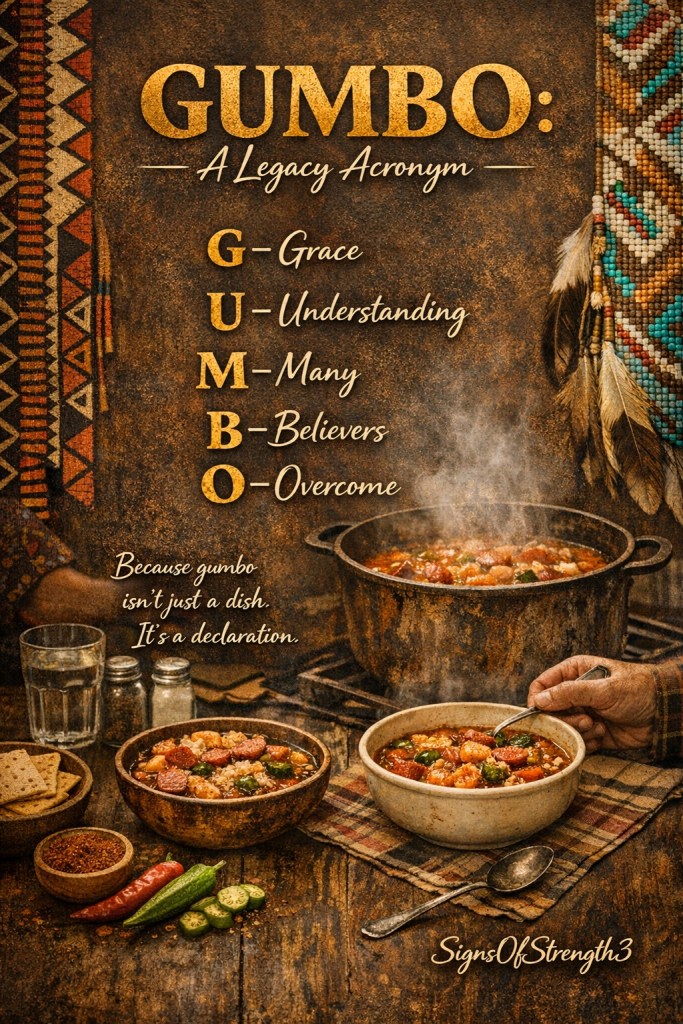
GUMBO: A Legacy Acronym
G — Grace
U — Understanding
M — Many
B — Believers
O — Overcome
Because gumbo isn’t just a dish.
It’s a declaration.
Scripture of the Week
“For I know the plans I have for you,” declares the Lord,
“plans to prosper you and not to harm you,
plans to give you hope and a future.”
— Jeremiah 29:11
Even when life feels mixed, messy, or uncertain —
God is still stirring the pot.
Prayer
Father, thank You for the gumbo of our lives — the mix of joy, pain, culture, sacrifice, and strength that shaped who we are.
Teach us to honor every ingredient, even the ones we didn’t choose.
Help us release the pressure to live life one “right” way and embrace the unique recipe You’ve given each of us.
Stir up new purpose, new identity, new confidence, and new love within us.
Bless every woman reading this with clarity, courage, and the boldness to begin again.
Amen.
Call to Action: Let’s Stir the Pot Together
This week, honor one ingredient in your life that you used to overlook.
Maybe it’s your resilience.
Maybe it’s your creativity.
Maybe it’s your motherhood.
Maybe it’s your healing.
Maybe it’s your voice.
Write it in your journal or drop it in the comments:
“This is part of my gumbo — and I’m proud of it.”
Because gumbo belongs to the people.
And your life belongs to you.
 SignsOfStrength