Tag: jesus

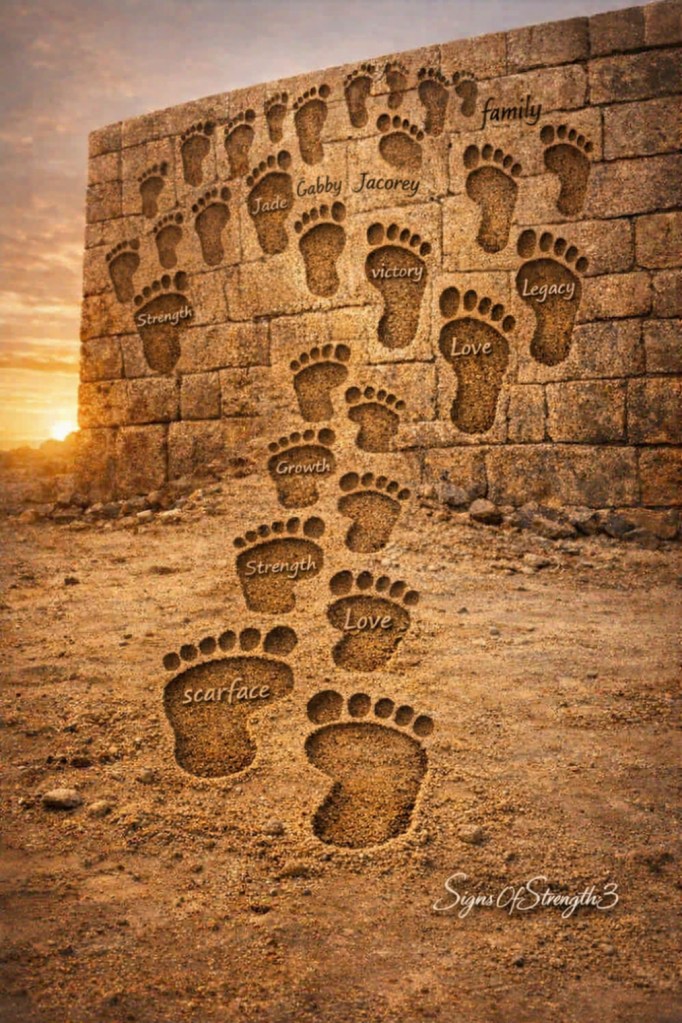
  • Footprints: The Steps We Take, The Legacy We Leave

    Let’s Talk About It

    The Meaning of a Footprint

    Our feet are not simply the pedestals on which we stand or the motors by which we move. They are the foundations of our presence in the world. Every footprint we leave behind carries a message — a blend of our humanity and the divine imprint of the One who guides our steps. Some prints show where we’ve struggled, some show where we’ve grown, and some reveal the quiet places where God carried us when we couldn’t carry ourselves.

    For years, I never paid attention to how powerful a footprint really is. But the more I studied, the more I realized: our feet tell the truth about our journey. They tell the truth about our ancestors’ journey too. Some of them walked far. Some of them stood firm. Some of them never made it to the places they dreamed of — but their standing became the ground we now walk on.

    A footprint is never just a mark in the dirt. It is evidence of existence. Evidence of endurance. Evidence of purpose.

    What a Footprint Really Is

    A footprint is the impression left by a foot or shoe on a surface. But spiritually and symbolically, it is so much more. It is the path we choose. It is the weight we carry. It is the impact we leave behind. It is the story our life is telling.

    Some people believe their feet took them far. Others are still standing in the same place — but even standing is a form of strength. Even standing leaves a mark.

    When you think about it, our feet are powerful. They carry our purpose, our pain, our progress, and our prayers. They carry the parts of us we show the world and the parts we hide. They carry the dreams we’re chasing and the burdens we’re trying to release.

    Our footprint is the proof.

    The Footprints of Our Ancestors

    Our ancestors left their footprint long before we took our first step. Their footprints weren’t just physical — they were emotional, cultural, spiritual.

    Footprints of survival.
    Footprints of sacrifice.
    Footprints of faith.
    Footprints of prayers whispered over generations.

    We are walking in paths they carved, carrying dreams they never got to finish, and living in answers to prayers they prayed.

    Their footprints didn’t end.
    They extended into us.

    The Footsteps of Those Who Came Before Us

    When I think about the power of a footprint, I can’t help but think about our ancestors — especially those who survived slavery. Many of them had nothing but their feet. No transportation. No protection. No freedom. No guarantee of tomorrow.

    All they had was the strength to run, the courage to walk, and the will to keep moving.

    Their feet carried:
    chains
    hope
    fear
    prayers
    survival
    determination

    Some ran toward freedom.
    Some walked through pain.
    Some stood their ground when standing was all they could do.

    And every one of them left a footprint behind — a mark that says, “I was here. I endured. I survived. I mattered.”

    Those footprints didn’t disappear.
    They became the path we walk today.

    The Legacy of a Footprint

    Tyler Perry once said he is living his footprint — and he has created so many millionaires that his steps will be remembered long after he’s gone. That’s the power of a footprint. It’s not about fame. It’s about impact. It’s about who rises because you walked.

    Some people leave footprints that build bridges.
    Some leave footprints that break generational curses.
    Some leave footprints that open doors for others.

    Footprints are not always loud.
    Sometimes they are quiet, steady, faithful steps that change everything.

    The Footprints Our Children Leave

    Just as our ancestors left their mark, our children are leaving theirs too.

    Some footprints are made over a lifetime, and some are made early — long before the world expects them. My oldest daughter is one of those souls whose steps have always carried purpose. At a young age, she began leaving footprints that stretched farther than her age, her size, or her circumstances.

    She was the first Black girl to win School of Rock All Star in Sugar Land, and that alone carved a path no one had walked before her. She didn’t just perform — she shifted the room. She is actively leaving her mark on the theater community — every role she steps into becomes a footprint they still talk about.

    And she didn’t stop there — she’s still going.

    She continues to leave her footprint in theater with every role she steps into. She has taken on so many impressive characters, including playing Ariel in The Little Mermaid — a role that lit up the stage and showed everyone exactly who she is. And she is still being cast, still performing, still growing, and still building a path that is uniquely hers.

    She became President of the Student Alliance, a leader whose voice carried weight, compassion, and courage. She will graduate college with a legacy already established — not because she tried to be impressive, but because she walked with intention. Every stage she stepped on, every room she entered, every challenge she faced… she left a footprint.

    A footprint of excellence.
    A footprint of resilience.
    A footprint of representation.
    A footprint of faith.

    She became a top winner at the NAACP, adding yet another mark to a path she is still building. And the beauty of it all is this: she is still young, still growing, still becoming — yet her footprints already speak loudly.

    Some people spend a lifetime trying to leave a legacy.
    Some children are born with one in their feet.
    The Footprints Still Forming

    Not every footprint is loud. Not every footprint is fully shaped yet. Some are still forming.

    My youngest daughter is discovering her own steps — learning who she is, what she carries, and what path she wants to walk. Her footprint is gentle right now, but it’s growing stronger every day.

    And my son… he slipped off his path for a moment. Life will do that. But I believe in the power of a returning step. I believe in the strength of a footprint regained. He is fighting his way back, and when he does, his story will leave a footprint worth remembering.

    Some footprints are early.
    Some are steady.
    Some are lost and found again.
    But all of them matter.

    Why One Step at a Time Matters

    And now I understand why people say, “Just keep putting one foot in front of the other.” It’s not just a motivational quote — it’s a survival strategy.

    It’s a reminder that progress doesn’t always come in leaps. Sometimes it comes in slow, steady, intentional steps. Sometimes it comes in the days when you don’t feel strong, but you move anyway. And sometimes it comes in the seasons where standing still is the bravest step you can take.

    We don’t always realize how important our feet are — not just physically, but spiritually and historically. Our feet carry our entire story. They carry our weight, our wounds, our victories, our faith, and our future.

    Every step mattered.

    The Footprint I’m Learning to Leave

    And here’s where my truth comes in.

    I’m guilty. For years, my objective was to push my oldest daughter to become everything I wasn’t. To be better. To go farther. To win where I had lost. I wasn’t trying to control her — I was trying to redeem the parts of myself I thought were too broken, too late, or too far gone.

    But life has a way of humbling you.

    I made bad decisions. I got stuck in my own way. I lost time I can’t get back. But I never gave up. And somewhere in the middle of all that stumbling, I realized something important:

    Growth doesn’t come from perfection.
    Growth comes from refusing to stay stuck.

    I can’t rewrite my past, but I can shape my footprint. I can leave a mark that my youngest daughter can stand on. I can walk in a way that shows her what strength looks like, what healing looks like, what accountability looks like, what faith looks like.

    I’m standing on my footprint now — not the one I wish I had, but the one I’m choosing to create.

    How Will You Leave Your Footprint?

    Every one of us is leaving a trail — through our choices, our healing, our faith, our mistakes, our growth, and our courage.

    Some footprints are loud.
    Some are quiet.
    Some are messy.
    Some are holy.
    Some are still forming.

    But all of them matter.

    Your ancestors left theirs.
    Your children are leaving theirs.
    You are shaping yours right now — with every step you take.

    Every step tells a story.

    What footprint will you leave behind?

    👣 👣 👣


  • You’re Not Too Grown to Listen: A Real Conversation About Parents, Respect, and Growing Up


    Before we dive into today’s message, I want to speak to your heart for a moment — whether you’re a parent, a teenager, or a grown adult still learning life one day at a time.

    This is a safe space. A space for honesty. A space for reflection. A space where nobody is pointing fingers, and nobody is perfect.

    Life is hard. Family is complicated. And sometimes the people who love each other the most end up hurting each other the deepest — not because they wanted to, but because they didn’t know how to communicate, how to listen, or how to understand what the other person was carrying.

    So take a breath. Relax your shoulders. Let your heart soften just a little.

    This message isn’t here to blame you. It isn’t here to shame you. It isn’t here to make you feel small.

    It’s here to help you see each other again — parent to child, and child to parent — with a little more grace, a little more understanding, and a little more truth.

    Because no matter how old we get, no matter how much we think we know, we all still need guidance. We all still need love. We all still need someone who cares enough to tell us the truth.

    Now… let’s talk about it.


    Parents Are Not the Enemy

    We all struggle in some area. We all have flaws. We all have moments we wish we handled differently.

    But if you have a mom or dad who cares — despite their faults, despite their mistakes, despite the things you blame them for — give them grace.

    Some of you are mad at your parents for things they didn’t even know they were doing wrong. Some of you are holding grudges for things you never talked about. Some of you are punishing your parents for not being perfect… while forgetting they were learning life at the same time they were raising you.

    Being a parent is not easy. And it’s different for everyone.


    A Personal Truth: Forgiveness Changes Everything

    I forgave my mom — and it was one of the best decisions I ever made. I didn’t want to live with “what if” or “I wish I had.” You lose time holding grudges. You lose connection. You lose moments you can’t get back.

    And if your mom or dad sacrificed for you — even if they made mistakes — why would you throw the whole relationship away over something that could be talked out?

    Especially when the issue is miscommunication… or you simply thought they could’ve done better.


    Let’s Define “Grown”

    A lot of people think being grown means:

    • paying one bill
    • having a job
    • having an attitude
    • or being able to talk back

    But being grown is deeper than that.

    Being grown means:

    • taking accountability
    • listening even when you don’t agree
    • respecting the people who raised you
    • understanding you don’t know everything
    • being humble enough to receive wisdom

    Some of y’all swear you’re grown because you turned 18… but you still call your mama when your tire light comes on. You still ask your daddy to look at your car. You still need advice when life hits.

    So let’s stop acting like listening is optional.


    Let’s Define “Respect”

    Respect is not:

    • agreeing with everything
    • letting someone control you
    • pretending your parents were perfect

    Respect is:

    • listening
    • honoring
    • communicating
    • not talking to your parents like they’re your little friends
    • understanding they’re human too

    You can disagree respectfully. You can set boundaries respectfully. You can express your feelings respectfully.

    But disrespect? That’s never the answer.


    Parents Carry Struggles Children Never See

    Children don’t know the struggle parents carry. They don’t know the sacrifices. They don’t know the nights you cried, prayed, or went without so they could have something.

    They don’t know the pressure. They don’t know the fear. They don’t know the weight of trying to raise a child while still trying to grow yourself.

    And yet… they talk crazy. They judge. They assume. They act like they raised themselves.

    Grace goes both ways.


    A Message to Parents

    You’re not failing. You’re not alone. And you’re not crazy for wanting respect.

    Parenting is hard. Raising teenagers is harder. Raising adult children with opinions, attitudes, and selective memory? That’s a whole different level.

    But keep loving. Keep guiding. Keep praying. Keep showing up.

    Your voice still matters — even when they pretend it doesn’t.


    A Message to Children (Teenagers and Adults)

    You’re not too grown to listen. You’re not too grown to learn. You’re not too grown to receive correction. And you’re definitely not too grown to show respect to the people who gave you life.

    You don’t have to agree with everything. You don’t have to repeat their mistakes. You don’t have to live the way they lived.

    But you do have to honor them.

    Because one day… you’ll wish you had.


    Let’s Talk About It

    Where do you need to soften your heart?
    Where do you need to listen more?
    Where do you need to forgive?
    Where do you need to communicate instead of assume?

    You’re not too grown to listen.
    And you’re not too grown to heal.


    Prayer for Parents & Children

    Father, today we lift up every parent and every child — young, grown, and in‑between. You see the misunderstandings, the hurt feelings, the pride, the distance, and the unspoken words that sit between families. You see the parents who are trying their best, even when they feel unseen. You see the children who are struggling to understand what they’ve never had to carry.

    Bring healing where there has been confusion. Bring softness where there has been stubbornness. Bring clarity where there has been miscommunication. Teach parents how to guide with wisdom, patience, and love. Teach children how to listen with humility, respect, and understanding.

    Restore relationships that have been strained. Mend hearts that have been hardened. Break generational patterns that keep families divided. Remind us that forgiveness is freedom, and grace is a gift we all need.

    Cover every home with peace. Cover every conversation with Your presence. And cover every family with the strength to love each other the way You love us — fully, honestly, and without conditions.

    Amen.

  • Human Desire vs. God’s Design: Let”s Talk About Hard Topics Without Hate

    We live in a world where feelings are loud and truth is often uncomfortable. Conversations about sexuality, identity, and desire can easily turn hateful, but God calls us to something higher. This message explores the tension between human desire and God’s design, the battle between flesh and Spirit, and how to speak truth with compassion. It’s a word for men, women, and youth—anyone who has ever felt pulled between what they want and who God created them to be.


    When Love Isn’t Really Love

    People often use the word “love” to describe situations that are not love at all. A woman being abused will say, “But he loves me,” but abuse is not love. Someone being cheated on will say, “I love him,” but betrayal is not love. A person stuck in a toxic cycle will say, “We love each other,” but toxicity is not love.

    This is the danger of following feelings. Feelings can lie. The flesh can lie. Desire can lie. Just because something feels like love does not mean it aligns with God’s definition of love.


    God’s Original Design

    From the beginning, God created male and female with intention. Their bodies complement each other. Their union produces life. Their covenant reflects Christ and the Church. Their design is purposeful, not accidental.

    Biblically, marriage is always described as man + woman. Not because God hates anyone, but because His design brings order, clarity, and life.


    What Scripture Says About Same‑Sex Behavior

    The Bible addresses same‑sex behavior directly in Leviticus 18, Leviticus 20, Romans 1, 1 Corinthians 6, and 1 Timothy 1. These passages do not discuss orientation—they address behavior, and they place same‑sex acts outside God’s design.

    This is not about attacking people. This is about acknowledging what Scripture teaches. Truth is truth.


    When the Heart Feels Torn

    Some people feel completely at peace with their sexuality. Others feel conflicted, confused, or spiritually torn.

    I’ve heard people say:

    • “I know it’s wrong, but it’s the flesh.”
    • “My desires don’t match my faith.”
    • “I feel pulled in two directions.”

    That kind of inner conflict is real. It doesn’t make someone evil—it makes them human.

    And Scripture reminds us: “God is not the author of confusion, but of peace.”

    Confusion comes from desire, pressure, trauma, fear, and internal battles. Peace comes from God.


    Why Some People Hide

    People hide things when they feel torn inside—cheating, addiction, lust, jealousy, pride, secret relationships. Not because they’re monsters, but because they’re hurting, confused, or afraid.

    Some hide because they fear rejection.
    Some hide because they feel spiritually conflicted.
    Every story is different.


    When Culture Redefines Love

    Culture says, “Love is love.”
    But the Bible says, “God is love.”

    Culture says, “If I feel it, it must be right.”
    But Scripture says, “The heart is deceitful.”

    Culture says, “Follow your desires.”
    But God says, “Walk by the Spirit, not the flesh.”

    Culture changes. God does not.


    The Battle Between Flesh and Spirit (Romans 7 + Galatians 5)

    Every believer knows this battle.

    Paul said: “The good I want to do, I don’t do. The evil I don’t want to do, that I keep on doing.”
    That’s the flesh.

    The flesh wants what feels good.
    The Spirit wants what honors God.

    Galatians 5 says: “The flesh desires what is contrary to the Spirit, and the Spirit what is contrary to the flesh.”

    This is why temptation feels strong.
    This is why obedience feels hard.
    This is why people feel torn.

    This is not a “gay issue.”
    This is a human issue.


    Love vs. Lust: Knowing the Difference

    The world confuses love with desire, attachment, trauma, loneliness, and lust. But the Bible separates love from lust.

    Lust is fast, emotional, flesh‑driven, self‑centered, temporary, and confusing.
    Love is patient, kind, sacrificial, covenant, truthful, and clear.

    Lust takes.
    Love gives.
    Lust confuses.
    Love clarifies.
    Lust is flesh.
    Love is Spirit.

    This message speaks to men, women, and youth—because all of us battle the flesh.


    Talking About Hard Topics Without Hate

    Truth without love becomes harsh.
    Love without truth becomes compromise.

    Jesus walked in both.

    When He corrected sin, He didn’t shame people.
    He didn’t attack people.
    He didn’t humiliate people.

    He spoke truth with compassion.

    He said, “Go and sin no more,” not “You’re worthless.”

    This is how believers must speak today—especially on topics like sexuality, identity, desire, and sin.

    The goal is not to win an argument.
    The goal is to win a soul.


    Every Journey Is Different

    Some feel convicted.
    Some feel confused.
    Some feel torn.
    Some feel at peace.

    Every person has a story.
    Every person has a journey.
    Every person deserves compassion.

    Our role is to love, pray, speak truth, stand firm, and walk in compassion.
    Because real love—God’s love—always leads us back to truth.


    Closing Prayer

    Father, thank You for being the God who brings clarity where there is confusion and peace where there is inner conflict. Thank You for creating us with purpose, identity, and design.

    As we face hard conversations in a world full of noise, give us the courage to stand on truth, the compassion to speak with love, and the humility to examine our own hearts before we correct anyone else.

    Strengthen us in the battle between flesh and Spirit. Help us choose Your way over our desires, Your voice over our feelings, and Your design over the patterns of this world.

    Heal the places in us that feel torn, confused, or broken. Bring conviction where we’ve compromised and restoration where we’ve drifted.

    Teach us to love like Jesus—with truth that frees and grace that restores.


    Amen.

  • Where Do All These Beliefs Come From?

    🌍

    A Sunday Conversation About Faith, Culture, and the Search for God

    “Lets Talk About It “

    📖 Scripture of the Day

    “The Lord looks at the heart.”

    — 1 Samuel 16:7  

    “For we walk by faith, not by sight.”

    — 2 Corinthians 5:7

    These two verses anchor everything we’re about to explore.

    What Is Religion, Really?

    Religion is often taught as a set of rules, rituals, and requirements. But at its core, it’s supposed to be a path — a way to connect with something greater. Somewhere along the way, many of us inherited beliefs without understanding their roots.

    Lets Get Into It “

    Table of Contents

    1. Why I Wrote This  

    2. My Personal Journey Through Faith  

    3. Before Religion Had Names  

    4. Is It All Man‑Made?  

    5. “Is Your Religion Better Than Mine?”  

    6. A Quick Look at a Few Traditions  

    7. So Where Did It All Start?  

    8. The Heart of the Matter  

    9. Closing Reflection  

    10. Prayer  

    🗣️ 1. Why I Wrote This

    Because too many people feel confused, judged, or silenced by religious expectations.  

    Because I’ve asked these questions myself.  

    Because God is bigger than our labels, louder than our traditions, and closer than we think.

    This is not a sermon — it’s a conversation.  

    A moment to breathe, reflect, and ask honestly:

    Where do all these beliefs come from?

    🌱 2. My Personal Journey Through Faith

    I grew up baptized and Methodist on both sides of my family, so Christianity was my foundation. It was familiar, it was home, and it shaped the earliest parts of my spiritual identity. But as I got older, something in me wanted more than routine. I didn’t just want to follow religion — I wanted to understand it.

    That desire pushed me into a season of exploration, not out of confusion, but out of curiosity and hunger for truth.

    For several months, I spent time at the temple.  

    It was peaceful, quiet, and centered on meditation, discipline, and giving.  

    Being there taught me how to slow down, breathe, and listen — not just to God, but to myself.  

    It showed me that peace is a spiritual language, and sometimes silence teaches more than sermons.

    I also visited the Catholic church, which felt both familiar and structured.  

    The reverence, the rituals, the consistency — it reminded me that faith can be sacred, steady, and rooted in tradition.  

    It helped me appreciate the beauty of spiritual discipline and the comfort of community.

    Then there was Islam, which drew me in because of its commitment to discipline — the prayer schedule, the structure, the way the body and spirit work together to honor God.  

    The dedication, the self‑control, the intentionality — it spoke to me in a way I didn’t expect.

    Each place taught me something different.  

    Each experience added another layer to my understanding.  

    And each tradition showed me a new way people reach for God.

    My journey wasn’t about switching religions.  

    It was about seeing God through different lenses and realizing that people everywhere are trying to reach the same Source — just in different ways.

    🧠 3. Before Religion Had Names

    Acts 17:26–27 reminds us that long before labels existed, humans had questions.

    People looked at the stars.  

    Felt joy, fear, loss, love.  

    Wondered why they were here.  

    Reached for God in the best way they knew how.

    Religion didn’t start with denominations.  

    It started with humans searching for meaning.

    🧭 4. Is It All Man‑Made? Or Did God Have a Hand in It?

    James 4:8 — “Draw near to God, and He will draw near to you.”

    People answer this differently:

    – Some believe God revealed Himself in different ways across cultures.  

    – Some believe religion is humanity’s attempt to understand God.  

    – Many believe it’s both.

    But one truth remains:

    People everywhere are trying to get closer to God — even if the paths look different.

    🧱 5. “Is Your Religion Better Than Mine?”

    Ephesians 4:3 — “Make every effort to keep the unity of the Spirit…”

    Most religions teach:

    – humility  

    – compassion  

    – discipline  

    – love  

    – service  

    – forgiveness  

    But humans turn it into competition.

    God didn’t create comparison — people did.

    Your walk is your walk.  

    Your growth is your growth.  

    Your connection is your connection.

    🌤️ 6. A Quick Look at a Few Traditions

    (Understanding, not comparing)

    Buddhism

    – Inner peace  

    – Compassion  

    – Ending suffering  

    Catholicism

    – Tradition  

    – Sacraments  

    – Reflection  

    – Community  

    Southern Baptist

    – Scripture  

    – Personal relationship with God  

    – Direct worship  

    Islam

    – One God (Allah)  

    – Prayer  

    – Charity  

    – Fasting  

    – Discipline  

    – Moral character  

    Different expressions.  

    Different histories.  

    Same desire to grow spiritually.

    🪨 7. So Where Did It All Start?

    It started with people trying to understand:

    – God  

    – life  

    – purpose  

    – suffering  

    – morality  

    – community  

    – eternity  

    Over time, understandings became traditions.  

    Traditions became religions.  

    Religions became cultures.

    Different paths.  

    Different practices.  

    Same human desire:

    To get closer to God.

    ❤️ 8. The Heart of the Matter

    John 4:24 — “Worship in spirit and truth.”

    God isn’t looking at labels.  

    He’s looking at hearts.

    Not “What religion are you?”  

    But “Are you growing?”

    Not “What denomination do you claim?”  

    But “Are you becoming better?”

    Not “What rules do you follow?”  

    But “Are you seeking truth?”

    Your journey is valid.  

    Your questions are valid.  

    Your growth is valid.

    🪞 9. Closing Reflection

    You don’t have to have it all figured out.  

    You just have to be willing to ask, listen, and grow.

    Different paths, Different practices

    Same God searching for willing Hearts”

    10. Closing Prayer

    God, open our hearts to understanding.  

    Help us see beyond labels, traditions, and differences.  

    Teach us to honor You in spirit and in truth.  

    Guide our growth, strengthen our discipline, and purify our intentions.  

    Let our journey be rooted in love, humility, and sincerity.  

    And may every step we take bring us closer to You.  

    Amen.

  • Everyday Courage: The Strength You Don’t Give Yourself Credit For

    Courage sounds simple… until life asks you to actually use it. Most people imagine courage as something loud, dramatic, or heroic — but the truth is, you walk in courage every single day, often without even realizing it.

    Even in The Wizard of Oz, courage wasn’t introduced as a roar — it was revealed through a journey. The Cowardly Lion spent the entire movie believing he lacked courage, but what he didn’t see was that he was already acting bravely the whole time:

    • He kept walking the Yellow Brick Road even when he was afraid
    • He protected Dorothy when danger showed up
    • He faced things that terrified him because someone needed him

    That’s everyday courage. Not the absence of fear — but movement in spite of it.

    And just like the Lion, most of us don’t recognize our own courage because it doesn’t feel big or dramatic. It feels shaky. It feels unsure. It feels like, “I don’t know if I can do this… but I’m trying.”

    But that’s courage.

    There are four core types of courage we use in everyday life: Physical, Moral, Intellectual, and Emotional/Social courage. And whether you notice it or not, you tap into all four.


    Courage in the Bible Isn’t About Being Fearless

    The Bible never tells us to pretend we’re not afraid. It tells us to move with God anyway.

    Courage is obedience in the presence of fear — not the absence of it.

    Think about:

    • David, facing Goliath with nothing but faith and a sling
    • Joshua, stepping into leadership with trembling hands but a steady God

    “Be strong and courageous. Do not be afraid; do not be discouraged, for the LORD your God will be with you wherever you go.” — Joshua 1:9

    Courage is choosing God’s direction even when your knees are shaking.


    The Four Types of Courage You Use Every Day

    1. Physical Courage
      Not just running into danger — sometimes it’s simply doing something your body resists.

    Like:

    • Lying down on a lab bed to give blood even though you’re terrified
    • Showing up to a doctor’s appointment you’ve been avoiding
    • Taking care of your health even when it’s uncomfortable

    1. Moral Courage
      Doing what’s right even when it’s unpopular.

    Like:

    • Telling a loved one the truth about their high‑risk behavior
    • Speaking up when everyone else stays silent
    • Setting boundaries that protect your peace

    1. Intellectual Courage
      Being willing to question, learn, unlearn, and admit what you don’t know.

    Like:

    • Telling a colleague, “Your presentation was amazing — and it made me feel insecure”
    • Challenging old beliefs that no longer serve you
    • Being open to new ideas even when they stretch you

    1. Emotional/Social Courage
      The courage most people underestimate — the courage to be vulnerable, honest, and real.

    Like:

    • Redirecting a conversation that’s going the wrong way
    • Admitting when you’re hurt
    • Asking for help
    • Letting people see the real you

    You Demonstrate Courage Every Day

    Courage isn’t always a roar.
    Sometimes it’s a whisper that says, “Try again.”
    Sometimes it’s a boundary.
    Sometimes it’s a confession.
    Sometimes it’s a conversation you didn’t want to have.

    But every time you choose truth, growth, or obedience — that’s courage.

    And God sees it.

    Just like the Lion, you’ve had courage all along — you just didn’t recognize it because it didn’t feel like courage. But it was.


    Let’s Talk About It

    Where have you shown courage this week — even in small ways? You might be surprised by how strong you really are.


    Word of Encouragement

    Courage doesn’t always feel like courage in the moment. Sometimes it feels like shaking hands, a tight chest, or a quiet prayer whispered under your breath. But every time you choose honesty, growth, obedience, or truth — you are walking in a strength that God Himself placed inside you.

    You don’t have to roar to be brave.
    You don’t have to feel fearless to move forward.
    You just have to take the next step, trusting that God is already in the place you’re walking toward.

    You are stronger than you think.
    You are braver than you feel.
    And you are becoming someone who chooses courage even when nobody sees it but God.


    🙏🏽 Prayer

    Father, thank You for the quiet courage You place in us every day. Give us strength when we feel weak, clarity when we feel unsure, and peace when fear tries to rise. Teach us to trust Your presence in every step — the big ones and the small ones. Help us recognize the courage we already carry, and remind us that we never walk alone. Make us bold in truth, steady in faith, and confident in the purpose You’ve placed on our lives.
    Amen.

  • The Truth Behind Time: Lets Talk About It :

    Because truth be told…
    Some people want time to slow down.
    Some people get depressed because they’re not where they thought they should be by now.
    Some young people rush time like it’s a race.
    But in the end, no matter how we feel about it, one thing remains true:

    Time will keep going — whether we show up or not.

    And that’s why we need to talk about it.

    Time is one of the few things every single one of us gets — but none of us can control.

    Some people waste it.
    Some people fear it.
    Some people try to outrun it.
    And some of us… we’re finally learning how to respect it.

    The older I get, the more I realize this:
    Time is not the enemy. Mismanagement is.

    We blame time for what our boundaries allowed.
    We blame time for what our fear delayed.
    We blame time for what our heart wasn’t ready to face.

    But time didn’t do anything to us.
    It just kept moving.

    And here’s the truth most people don’t want to admit:
    Time will tell you the truth long before people do.

    Time exposes intentions.
    Time reveals character.
    Time shows you who’s consistent and who’s convenient.
    Time will show you what’s real and what was just a moment.

    But time also heals.
    Not instantly.
    Not magically.
    But gradually — in the quiet places where you finally stop fighting what happened and start accepting what’s next.

    I’ve learned to stop rushing seasons that were meant to grow me.
    I’ve learned to stop holding onto seasons that expired.
    And I’ve learned that when God says “wait,” it’s not punishment — it’s protection.

    Time is a teacher.
    A mirror.
    A filter.
    A healer.

    Time is not the enemy. Mismanagement is — especially when we don’t understand how important time really is.

    And if you let it, time will grow you into someone you didn’t even know you could become.


    📖 Psalm 90:10–12 — When Life Feels Short

    “The years of our life are seventy, or even by reason of strength eighty… So teach us to number our days that we may gain a heart of wisdom.”

    I saw this scripture come alive not long ago.

    A woman in her late 70s stood up at a community event and said,
    “I’ve lived a long time, but I didn’t start living wisely until I stopped trying to control everything.”

    That stayed with me.

    Because Psalm 90 isn’t just telling us life is short.
    It’s telling us to pay attention.
    To value our days.
    To stop acting like we have unlimited time to get it right.

    Wisdom doesn’t come from age alone.
    It comes from reflection, surrender, and learning how to use your time with intention.

    Life is long enough to learn — but too short to waste.


    ⏳ Part 2 — When You Think You’ve Lost Time

    There’s a moment in everyone’s life where you look back and think:

    “I should be further by now.”
    “I wasted too many years.”
    “I stayed too long.”
    “I didn’t know better.”
    “I missed my moment.”

    But here’s the truth:

    You didn’t lose time.
    You lived through lessons.
    And God can redeem every single one of them.

    Let’s go deeper.


    🔹 1. The Time You Think You Lost

    Regret is not proof of wasted time — it’s proof of growth.

    You see differently now.
    You choose differently now.
    You value differently now.

    That’s not wasted time.
    That’s wisdom forming.

    God doesn’t just restore years.
    He restores clarity, identity, and direction.


    🔹 2. The People Connected to Your Time

    Some of the time you “lost” was tied to people who were never meant to stay.

    Some drained your time.
    Some mishandled it.
    Some didn’t deserve it.
    Some were only meant to be a chapter, not the whole book.

    But losing the wrong people gives you back the right time.

    Everyone can’t go where your healing is taking you.


    🔹 3. God’s Timing vs. Your Timing

    This is where regret hits the hardest.

    You think you’re behind.
    You think you missed your moment.
    You think you should’ve been further.

    But God doesn’t operate on your clock.

    What you call “late,” God calls “on schedule.”
    What you call “delay,” God calls “development.”
    What you call “lost time,” God calls “protected time.”

    You weren’t ready then.
    You’re becoming ready now.


    🔹 4. Time and Transformation

    Some seasons weren’t wasted — they were working on you.

    You needed time to heal.
    Time to grow.
    Time to unlearn.
    Time to see yourself clearly.
    Time to stop settling.
    Time to stop shrinking.
    Time to stop repeating cycles.

    Transformation takes time — and time takes honesty.

    You’re not who you were.
    And that alone proves time wasn’t wasted.


    🔹 5. Time and Accountability

    This is the grown part.

    At some point, you stop blaming time…
    and you start managing it.

    You stop repeating patterns.
    You stop entertaining distractions.
    You stop giving energy to what drains you.
    You stop letting fear run your schedule.

    You start choosing differently.
    You start moving wisely.
    You start honoring the time you have left.

    This is where Colossians 4:5 comes alive:

    “Walk in wisdom toward outsiders, making the best use of time.”

    Wisdom is not just knowing better —
    it’s doing better with the time you have now.


    🔥 Part 3 — Redeeming the Time You Have Left

    Awareness is a gift.
    But action is obedience.

    There comes a moment where you realize:

    “I can’t keep living like I have unlimited time.”

    You don’t have forever to heal.
    You don’t have forever to change.
    You don’t have forever to become who God called you to be.

    This is the shift:

    My time has value, so my choices must too.

    You start protecting your peace.
    You start setting boundaries.
    You start choosing with intention.
    You start moving with purpose.

    You’re not starting over —
    you’re starting wiser.

    God can do more with your next than you ever did with your last.

    He restores years.
    He redeems seasons.
    He accelerates destiny.
    He honors obedience.

    Your time is not random.
    It’s divine.

    And this time?

    You’re not wasting time.
    You’re using it wisely.
    On purpose.
    With purpose.
    For purpose.

    So as you close this page, open your life.
    This is your reminder:
    Go live.
    Go love.
    Go be present.
    Go make time count.
    And appreciate every day — and every person — God trusted you with.
    Time is still moving… now it’s your turn to move with it.


    Prayer:

    Father, thank You for the gift of time — the seasons that grow us, the moments that shape us, and the lessons that guide us.Teach us to stop fighting time and start flowing with it.Help us release what has expired, embrace what is now, and trust what is next.Give us wisdom to recognize Your timing, patience to wait when needed, and courage to move when You say go.May every season — the hard ones, the healing ones, and the unexpected ones — draw us closer to who You created us to be.

    Amen.

  • Steadfast in the Storm

    Let’s Talk About It.

    Anybody can stand strong when life is calm.
    But being steadfast in the storm — that’s a different kind of strength.
    That’s the kind of strength you don’t learn from comfort.
    You learn it from loss.
    You learn it from starting over.
    You learn it from the moments that shake everything you thought was secure.

    Being steadfast doesn’t mean you don’t feel the storm.
    It means the storm doesn’t break you.

    It means you stay loyal to your purpose,
    firm in your faith,
    and unwavering in your decisions —
    even when everything around you is falling apart.

    And let’s be honest…
    Being steadfast when you’ve lost everything is one of the hardest things you will ever do.

    Starting over is not easy.
    Rebuilding takes courage.
    Choosing differently takes discipline.
    And staying grounded when life is shaking you takes a strength you don’t even know you have until you’re forced to use it.

    But every time you choose differently,
    you break a cycle.
    Every time you stay steadfast,
    you strengthen your foundation.
    Every time you refuse to fold,
    you prove the storm didn’t win.

    The Bible says:

    “Blessed is the one who remains steadfast under trial,
    for after standing the test,
    they will receive the crown of life
    that God promised to those who love Him.”

    James 1:12

    That verse isn’t about perfection.
    It’s about endurance.
    It’s about holding on when everything in you wants to let go.
    It’s about trusting that God sees your effort,
    your tears,
    your discipline,
    your growth —
    and He rewards those who don’t quit.


    Prayer

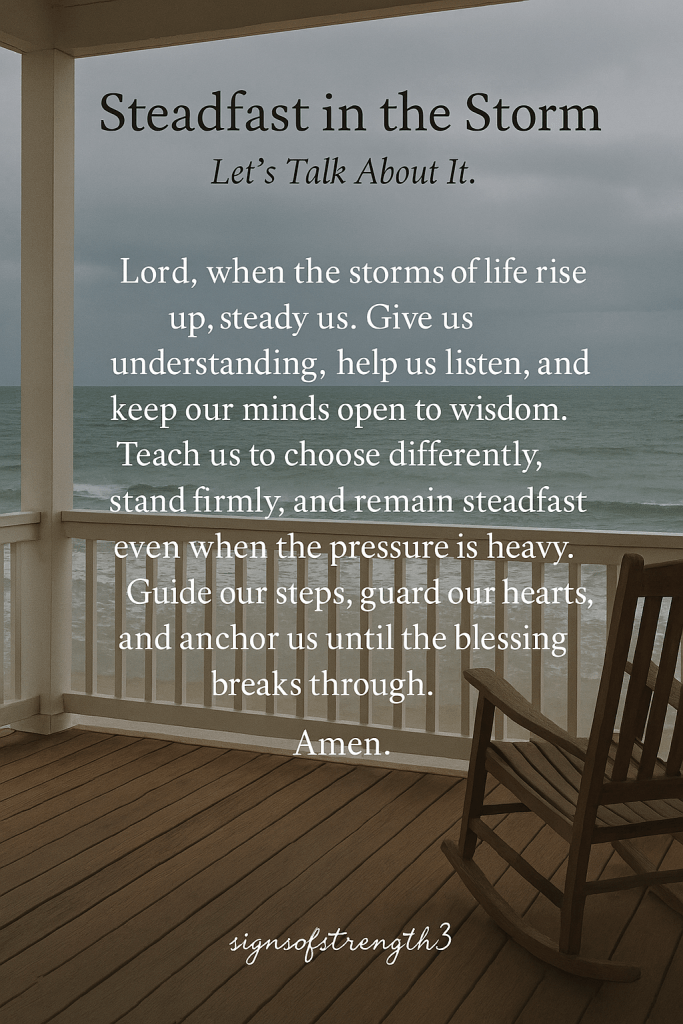
    Lord, when the storms of life rise up, steady us.
    Give us understanding, help us listen, and keep our minds open to wisdom.
    Teach us to choose differently, stand firmly, and remain steadfast even when the pressure is heavy.
    Guide our steps, guard our hearts, and anchor us until the blessing breaks through.
    Amen.


    Final Word

    A storm may shake you, but steadfastness will shape you — and what God builds in you cannot be broken.

  • Druski, The Church, and the Truth Behind the Laughter

    Let’s Talk About”

    When Druski dropped his “Mega Church Pastors Love Money” skit, the internet didn’t just laugh—it erupted. Forty‑three million views in a single day. Memes everywhere. Debates everywhere. And a whole lot of people suddenly feeling very uncomfortable.


    It Was Funny — But It Was Familiar

    The skit wasn’t random.
    It wasn’t an attack on God.
    It wasn’t disrespect for the sake of disrespect.

    It was satire rooted in reality.

    Druski exaggerated the theatrics—the pastor descending from the ceiling, the designer outfits, the dramatic “miracles,” the million‑dollar fundraising for a vague mission trip. But the reason people laughed is because some of us have seen versions of this in real life.

    Not all churches.
    Not all pastors.
    But enough for the joke to land.


    The Intent Was Clear

    Reporting made it clear: Druski created the skit as a response to hypocrisy and exploitation in certain megachurch spaces. He wanted to highlight the disconnect between:

    • Lavish lifestyles
    • And the spiritual messages being preached

    That’s why the skit sparked such a strong reaction—it wasn’t just comedy.
    It was commentary.


    Even Lecrae Spoke On It

    When someone like Lecrae—respected in both faith and culture—says the skit was funny because it’s true, that tells you everything.

    People aren’t mad at the joke.
    They’re mad at the mirror.


    Why the Backlash Was So Loud

    Whenever truth gets exposed, two groups show up:

    • Those who feel exposed
    • Those who feel seen

    The exposed get defensive.
    The seen feel relieved.

    That’s why the comments are split between:

    “Black churches don’t do this.”
    and
    “Actually… some do.”

    Both can be true.


    This Isn’t About Tearing Down the Church

    The Black church has been a place of healing, community, and survival for generations. It deserves honor.

    But honoring something doesn’t mean ignoring the parts that need accountability.

    Calling out manipulation is not an attack on God.
    Calling out theatrics is not an attack on faith.
    Calling out exploitation is not an attack on the church.

    It’s protection.


    Imagine Church & Accountability Sitting in the Same Room

    Not as enemies.
    Not as threats.
    But as partners.

    Imagine a church where leaders serve before they shine.
    Where transparency is normal, not optional.
    Where the stage is a tool, not a throne.
    Where people are protected, not performed for.

    Imagine a church where truth and love walk together again.

    That’s the vision.
    That’s the hope.
    That’s the conversation this skit accidentally opened.


    Let’s Be Real

    I didn’t watch the skit and get offended.
    I watched it and said, “This is a real issue—and that’s why it’s trending.”

    If we can laugh, we can learn.
    If we can be entertained, we can be honest.
    If we can call out the problem, we can protect the people.

    The goal isn’t to tear down the church.
    The goal is to keep it sacred—not staged.


  • It’s in the Book 📖

    Not hidden.
    Not coded.
    Not reserved for the “deep” or the “qualified.”

    It’s right there for anybody who will slow down long enough to actually read it.

    And the beautiful part is this:
    When Jesus says, “Come to Me,” He’s not inviting us into religion, performance, or pressure.
    He’s inviting us into relationship — and the proof is in the pages.


    Let’s Talk About It

    Some people flip through the Bible like it’s a checklist.
    A verse here. A chapter there.

    But if you ever pause — really pause — and read it for yourself, you’ll see something:

    It’s all there.

    The comfort.
    The clarity.
    The correction.
    The rest your soul has been begging for.

    Jesus didn’t hide His invitation.
    He said it plainly:

    “Come to Me… and I will give you rest.”

    Not stress.
    Not confusion.
    Not hoops to jump through.

    Rest.

    And the more you read, the more you realize:
    He meant every word.

    So today, take a moment.
    Open the Book.
    Let the words breathe again.
    Let them meet you where you are.
    Let them lift what you’ve been carrying.

    Because everything you’ve been searching for —
    it’s in the Book.


    Let’s pray 🙏🏽

    Lord, thank You for giving us a place to run when life gets heavy.
    Thank You for speaking rest to our souls through Your Word.
    Open our eyes to see what’s written, open our hearts to receive it,
    and remind us that Your invitation is always open, always gentle, always real.
    Meet us in the pages, and let Your truth settle us from the inside out. Amen.


    Invitation

    If you’ve been tired, searching, overwhelmed, or carrying more than you admit…
    start with one moment today.
    One verse.
    One pause.
    One breath.

    You don’t have to perform.
    You don’t have to qualify.
    You don’t have to figure everything out.

    Just come.
    Just open the Book.
    Just let Him meet you.

    Because relationship starts with a response —
    and He’s already extended the invitation…

  • Let’s Talk About It: Understanding Fashion, Leadership, and Public Perception

    Let’s talk about it — because clearly the internet has been talking.

    Over the past few days, people have ask me what I think about Dr. Karri Turner Bryant’s gown at the UNCF Mayor’s Masked Ball. And honestly, I wasn’t planning to say anything. But since the conversation keeps circling back to me, let’s go ahead and unpack it.

    First of all, I’ve always liked her.
    She’s been bold, fashionable, and unapologetically stylish long before she married Pastor Jamal Bryant. Her style didn’t suddenly appear because of a title. The only thing that changed was the spotlight.

    Now, yes — the dress went viral.
    Yes — people had opinions.
    And yes — the internet did what the internet does.

    Some folks said it was too revealing.
    Others said it was a gala, not a church service.
    And Pastor Bryant himself said he bought the dress, approved the dress, and reminded everyone that she’s married to him — not the internet.

    But here’s where I land:

    This conversation is bigger than a dress.

    It’s about leadership.
    It’s about visibility.
    It’s about the expectations placed on women — especially women connected to ministry.

    Because let’s be honest…
    Most women know when an outfit is going to turn heads.
    We know when we’re stepping into “statement” territory.
    That’s not judgment — that’s awareness.

    And here’s the part people forget:

    The title “First Lady” isn’t biblical.
    It’s a cultural role the church created.
    And once that title is placed on you, whether you asked for it or not, people expect representation.
    Not perfection. Not bondage. But wisdom.

    Leadership doesn’t clock out.
    Visibility doesn’t turn off.
    Influence is a mantle, not a mood.

    So my stance is simple:

    I respect her freedom as a woman.
    I understand her intention.
    But I also recognize that when you’re connected to spiritual leadership, your choices echo louder — even at a gala.

    She didn’t change.
    The spotlight did.

    And that’s why the conversation is happening.


    A Prayer for Women in Leadership

    Father, we lift up every woman You’ve called to lead — in the church, in the home, in business, in community, and in every space where her presence carries weight.

    Strengthen her shoulders for the mantle she carries.
    Remind her that leadership is not about perfection, but about purpose.
    Cover her mind from the noise of public opinion and anchor her identity in You alone.

    Give her wisdom to navigate visibility with grace.
    Give her discernment to know when to speak and when to be still.
    Give her confidence to walk boldly in the gifts You placed inside her long before any title was attached to her name.

    Protect her heart from comparison, criticism, and pressure.
    Let her know she is not defined by a moment, a mistake, or a misunderstanding — but by Your calling, Your covering, and Your love.

    Surround her with people who see her humanity, not just her role.
    People who pray for her, not prey on her.
    People who uplift her, not use her.

    And Lord, remind every woman in leadership that she is allowed to grow, evolve, and be fully herself — even under the spotlight.
    Let her shine without shame.
    Let her stand without shrinking.
    Let her lead without losing the softness You gave her.

    May her life reflect Your glory.
    May her choices reflect Your wisdom.
    And may her journey reflect Your grace.

    In Jesus’ name, Amen.